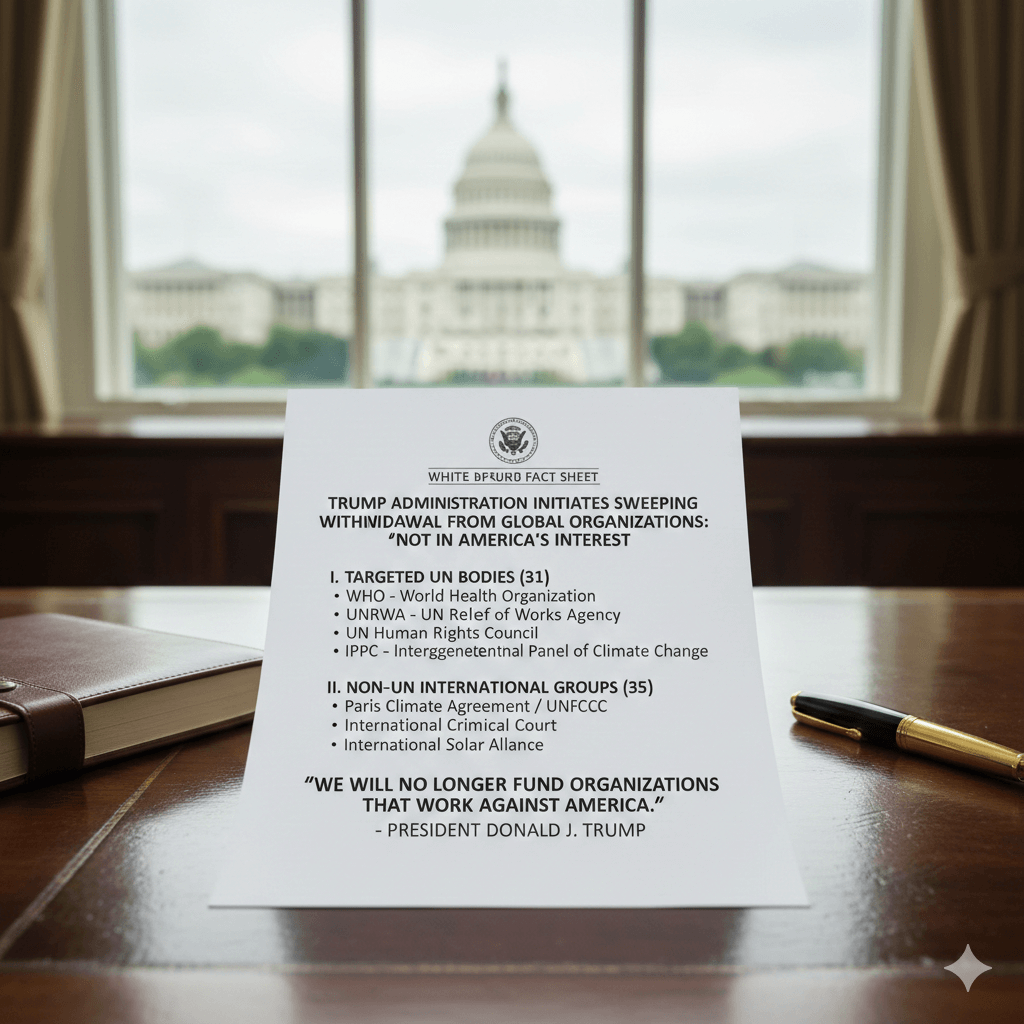
In a move that was long overdue, President Trump has officially signed a sweeping executive order to withdraw the United States from 66 international organizations.
On January 7, 2026, the White House released a fiery new fact sheet framing the decision as a necessary reclamation of American sovereignty. The administration’s message is clear: the era of writing blank checks to organizations that work against American values is over. President Trump characterized these entities as “bloated, corrupt, and hostile to American interests,” vowing that U.S. taxpayer dollars will no longer fund “global elites” at the expense of the American people.
Breaking the Chains of Global Governance
For decades, the United States has been the primary benefactor of a sprawling network of international bodies. However, the current administration argues that what began as a framework for peace has morphed into an “NGO-plex” dominated by radical ideologies.
The withdrawal targets a staggering 31 UN bodies and 35 non-UN groups. While the full implications are still being processed, the list includes some of the most prominent names in global diplomacy:
- The World Health Organization (WHO): Cited for mismanagement and lack of accountability.
- UNRWA: Terminated due to concerns over its role in the Near East and conflicts with U.S. policy.
- The Paris Climate Agreement & UNFCCC: Labeled as “climate orthodoxy” that hampers American energy and economic strength.
- UN Human Rights Council: Criticized for providing a platform to human rights abusers.
- International Solar Alliance: Exited to refocus on domestic thermal energy and American jobs.
“We will no longer fund organizations that work against America,” Trump declared. “It is no longer acceptable to be sending the blood, sweat, and treasure of the American people to institutions with little to nothing to show for it.”
Redirecting Billions to “America First” Priorities
The financial implications of this exit are massive. By cutting ties with these 66 organizations, the administration plans to redirect billions of dollars toward domestic security and infrastructure. Key beneficiaries of this “Sovereignty Boost” include:
- Border Security: Funding for the wall and advanced surveillance technology.
- Military Readiness: Modernizing the U.S. armed forces to maintain a competitive edge.
- National Infrastructure: Investing in American roads, bridges, and energy independence.
A Divided Global Response
The reaction to this “January 7th Decree” has been polarized.
Supporters hail the move as a long-overdue power play. They argue that international organizations have used U.S. funding to push “DEI mandates,” “gender equity campaigns,” and “global tax deals” that undermine the U.S. Constitution. For the “America First” base, this is a moment of liberation from a “discredited fantasy of the End of History.”
Critics, however, worry about isolationism. Diplomatic circles are buzzing with concerns that by “slamming the door,” America is ceding its seat at the table to rivals like China. They argue that leaving scientific bodies like the IPCC (Intergovernmental Panel on Climate Change) leaves the U.S. “flying in the dark” while other nations set the rules for the 21st-century economy.
The Last Word
Whether this is a strategic masterstroke or a retreat from the global stage remains to be seen. What is certain is that President Trump is making good on his promise to dismantle the “globalist project.” By prioritizing prudence and purpose over inertia and ideology, the administration is betting that a stronger, more independent America is better for the world than an America tethered to the whims of international bureaucrats.
As Secretary of State Marco Rubio put it: “We reject inertia and ideology in favor of prudence and purpose. We seek cooperation where it serves our people and will stand firm where it does not.”
Previous Politics posts