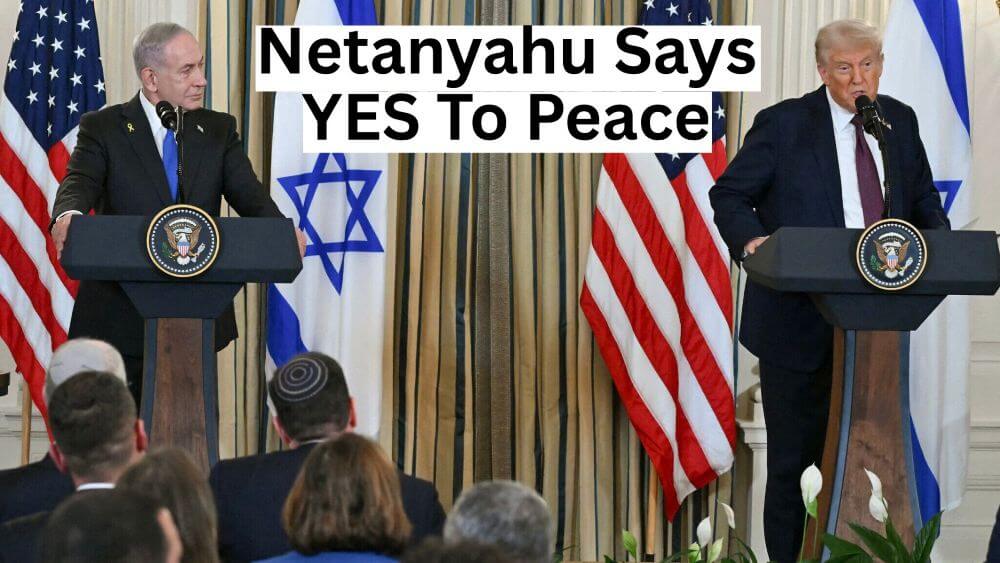
Today marked a major turning point in global diplomacy as former U.S. President Donald J. Trump met with Israeli Prime Minister Benjamin Netanyahu to discuss a new peace initiative aimed at ending the war in Gaza and stabilizing the wider Middle East.
While critics have debated his style for years, one thing has become increasingly clear: Trump has positioned himself as a president of action, particularly when it comes to ending long-standing conflicts. From mediating six global disputes during his time in office to brokering the groundbreaking Abraham Accords, Trump’s foreign policy legacy is centered not on endless wars—but on strategic peace deals. The world, whether it admits it openly or not, owes him a debt of gratitude for restoring diplomacy as a tool of strength.
Netanyahu: “You Are Leading the World Toward Peace”
In today’s meeting, Prime Minister Netanyahu offered rare and direct praise for Trump’s leadership:
“I support your plan to end the war in Gaza, which achieves our war aims. It will bring back to Israel all our hostages, dismantle Hamas’ military capabilities and its political rule. And ensure that Gaza never again poses a threat to Israel.”
This marks a significant shift. Netanyahu—who has historically rejected international pressure to recognize Palestinian statehood—is now openly endorsing a plan that acknowledges Palestinian governance, albeit under strict demilitarization terms. Analysts suggest domestic pressure from hostage families and shifting public opinion may be driving the pivot.
Inside Trump’s Peace Proposal
According to early reports from The White House, Trump’s proposed plan includes:
✅ Immediate 72-hour ceasefire
✅ Full hostage release
✅ Disarmament and exclusion of Hamas from governance
✅ Creation of a technocratic Palestinian administration, overseen by an international supervisory board chaired by Trump himself
✅ Long-term security guarantees for Israel
✅ A U.S.-funded weapons buyback program, similar to prior disarmament models but with stricter compliance enforcement
The plan aligns with the broader Gaza Reconstitution, Economic Acceleration, and Transformation (GREAT) Trust, a U.S.-led economic framework contingent on post-war stabilization.
A New Phase of the Abraham Accords
This meeting is being labeled by insiders as “Abraham Accords 2.0.”
Under Trump’s leadership in 2020, Israel normalized relations with the UAE and Bahrain—an achievement once considered impossible. Now, discussions are reportedly underway to expand the accords to countries such as Libya, Azerbaijan, and Armenia.
Unlike past U.S. administrations that promised peace but delivered only speeches, Trump is reviving an action-driven doctrine:
Peace through leverage. Peace through strength. Peace with terms.
A Turning Point
While optimism is growing, so is tension. With over 60,000 lives lost in Gaza according to The Washington Post, and ongoing disagreements over governance between Israel, Qatar, the Arab League, and Western powers, the road ahead is uncertain.
But if today proved anything, it’s this:
There is now a real plan — not just slogans.
And whether one loves or hates Donald Trump, it is undeniable that he is once again at the center of a conversation most world leaders have avoided for decades.
If Trump and Netanyahu succeed, we may be witnessing the beginning of the most consequential peace agreement of the 21st century.
And history, when written, may say that peace in the Middle East did not begin with committees — but with two leaders sitting down and saying:
Enough.
Previous Politics posts