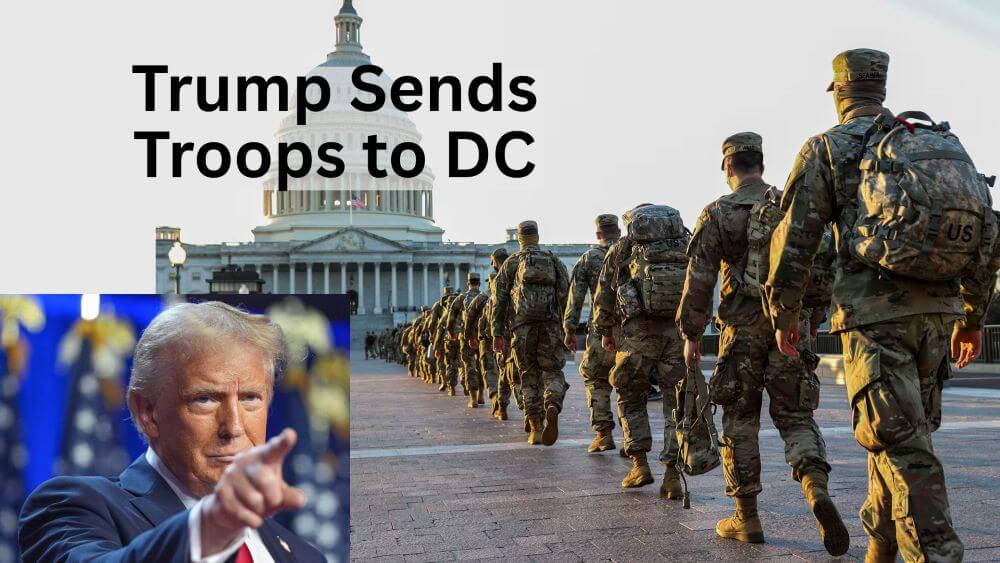
On August 11, 2025, President Donald Trump deployed 800 National Guard troops to Washington, D.C., and seized control of the city’s police department in what he called a “public safety emergency.” This decisive D.C. police takeover comes amid soaring crime rates, rising gang violence, and expanding homeless encampments in the nation’s capital. Under emergency powers granted by the Home Rule Act of 1973, Trump’s order places the Metropolitan Police Department under federal command, with Attorney General Pam Bondi overseeing operations. Federal agents from the FBI, ICE, DEA, and ATF have already joined the effort, aiming to restore law, order, and safety to Washington’s streets.
Speaking from the White House, Trump declared:
“Our capital city has been overtaken by violent gangs and bloodthirsty criminals. This is ‘Liberation Day’ in Washington, D.C., and we’re going to take our capital back.”
The president’s remarks were not mere rhetoric. In addition to the National Guard deployment, hundreds of agents from the FBI, ICE, DEA, and ATF have already been mobilized. Attorney General Pam Bondi has been appointed to oversee the Metropolitan Police Department during this federal takeover, while newly sworn-in U.S. Attorney Jeanine Pirro will target lenient bail laws and juvenile crime policies.
Why This Move Matters
This action is not about politics—it’s about public safety.
For too long, D.C. has suffered under soft-on-crime policies that protect criminals more than law-abiding citizens. Residents have been forced to live alongside sprawling homeless encampments, open-air drug markets, and violent street gangs. Businesses have been looted, public spaces have become unsafe, and families fear walking at night.
Less crime is always good. Less homelessness on the streets is always good. More safety for residents and visitors is always good.
Opposition to this decision comes almost entirely from political lines, not from genuine concern for the well-being of D.C. residents. If we are serious about protecting our communities, then we need serious enforcement, and that’s exactly what this move delivers.
The Legal Authority
The Home Rule Act of 1973 allows the president to assume temporary control over the D.C. police in times of emergency. Today, Trump signed two executive orders:
- Declaring a public safety emergency in Washington, D.C., and placing the police department under federal authority.
- Mobilizing the D.C. National Guard to conduct targeted operations against gangs, drug dealers, and other criminal networks.
This is not a permanent takeover—it’s a targeted, decisive intervention to restore order.
A Turning Point for D.C.
Attorney General Bondi promised immediate results:
“Let me be crystal clear—crime in D.C. is ending, and ending today. We will use every power we have to find criminals here.”
This is the kind of leadership the city has been missing for decades. Federal intervention is not a sign of weakness—it’s a sign that the government is finally taking responsibility for the safety of its people.
If successful, this could serve as a model for other crime-plagued cities, such as Chicago or Los Angeles, both of which Trump hinted could face similar action if local leaders fail to act.
Final Thoughts
When cities fail to protect their citizens, it’s not just a local issue—it becomes a national problem. Washington, D.C., is not just another city. It’s the symbolic heart of the United States. Allowing it to fall into chaos is unacceptable.
Trump’s move today is a necessary and overdue step toward restoring law, order, and pride in our nation’s capital.
Those who oppose it aren’t standing for freedom—they’re standing in the way of safety.
Today is indeed Liberation Day for Washington, D.C.
Other Law Posts