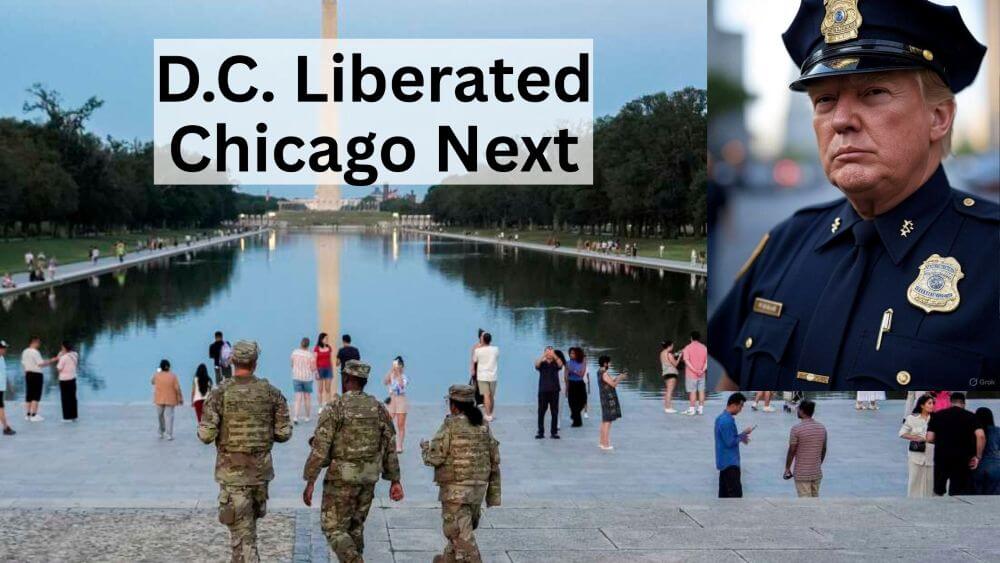
On August 22, 2025, Donald Trump held a press conference in the Oval Office where he claimed victory over crime in Washington, D.C., and announced plans to extend his “liberation strategy” to other American cities, beginning with Chicago.
According to Trump, Washington has already seen a dramatic turnaround thanks to the deployment of the National Guard. He painted a picture of a city revitalized—restaurants filling up again, cleaner streets, and a capital city “looking like the capital of a great nation, and not like a dump.”
Chicago Is Next
Trump declared that his next major focus will be Chicago, a city he has long criticized for high crime rates. He asserted that local residents, especially African-American women, are urgently requesting his intervention. While Trump offered no evidence to back up this claim, he suggested that his popularity with this demographic is growing as a result of his law-and-order policies.
Whether this reflects genuine grassroots support or political posturing remains unclear. What is clear, however, is that Trump intends to make crime control one of the cornerstones of his second-term agenda.
National Guard Expansion
The President also revealed a broad deployment of National Guard troops across 19 states. These troops will work alongside the Department of Homeland Security (DHS) in what he described as a “major crackdown” on immigration and federal crimes.
Trump emphasized that the Guard is not acting alone but rather as a “support pillar” for federal law enforcement agencies. This marks a significant escalation in the use of military resources for domestic policing, a move likely to spark heated debate over civil liberties, federal overreach, and the balance of power between local and federal authorities.
Political Implications
Trump framed the initiative as a response to the demands of the 78 million Americans who voted for him, citing Fox News as the source of this mandate. His rhetoric suggests he views crime reduction and strict immigration enforcement as issues that will keep his base energized heading into the next electoral cycle.
But critics argue that Trump’s claims of success in Washington lack transparency and data. Independent crime reports from D.C. have yet to validate his assertions of major reductions, and the long-term effects of militarized policing remain to be seen.
Conclusion
Trump’s announcement underscores his ongoing effort to position himself as the protector of America’s cities, willing to bypass traditional governance structures in favor of direct federal intervention. Whether this strategy leads to safer streets—or deeper political division—remains an open question.
For now, Trump is riding the narrative of victory in Washington and promising to “liberate” more cities, starting with Chicago.
Other Law Posts