For decades, the American Dream has been built on a foundation of homeownership. It’s the primary way families build wealth, stability, and a sense of community. But in recent years, that dream has felt increasingly out of reach for the average person.
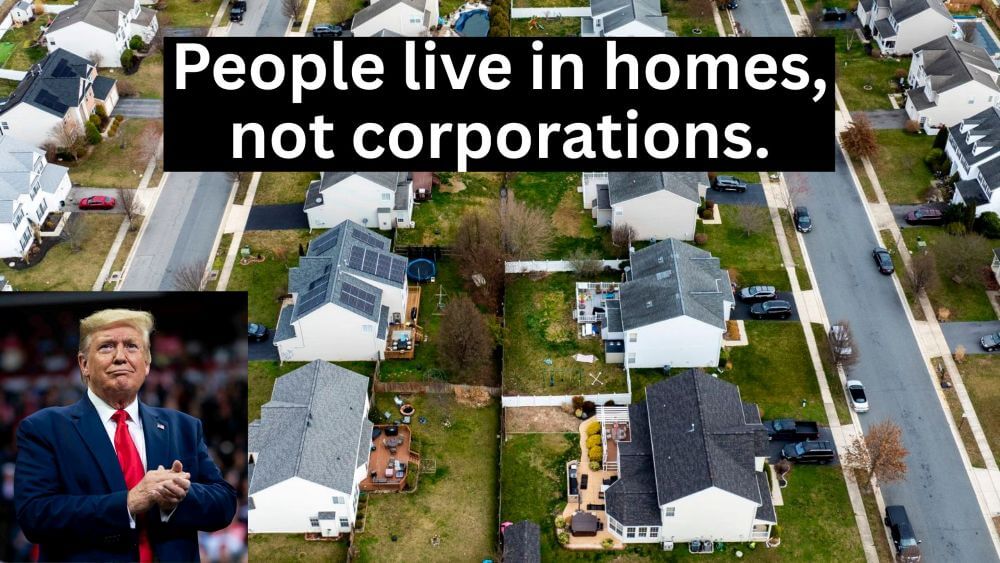
President Donald J. Trump recently took a bold stand on this issue, announcing steps to ban large institutional investors from buying single-family homes. His message was clear and resonant: “People live in homes, not corporations.”
I think this policy shift represents a significant victory for individual consumers over Wall Street interests. Here is why this move matters for your wallet and your future.
The Rise of the Corporate Landlord
Historically, the single-family home market was the domain of families and small-scale “mom and pop” investors. However, following the 2008 financial crisis, massive hedge funds and institutional investors began sweeping up properties by the thousands.
While these institutions own about 3% of single-family rentals nationwide, their impact is felt most acutely in “hot” markets. In cities like Atlanta, institutional investors have controlled up to 25% of the market.
Why This is a Win for Consumers
When you are looking to buy a home, you shouldn’t have to outbid a multi-billion dollar corporation with access to infinite credit. Here is how this ban helps the average buyer:
- Lowering Artificial Price Hikes: A 2025 St. Louis Fed study found that in areas with high corporate activity, home prices were pushed up by 2-5% simply due to institutional outbidding. By removing these “whales” from the pool, prices can stabilize based on local demand.
- Increasing Inventory for Families: When corporations buy homes, they often turn them into permanent rentals. This removes the “starter home” from the cycle of ownership. Returning these homes to the market increases the supply available for first-time buyers.
- Restoring Homeownership Rates: Data from a 2025 University of Colorado analysis showed that homeownership rates dropped by 2 percentage points in investor-heavy areas. Reversing this trend is essential for middle-class wealth building.
Addressing the Skeptics
Critics argue that institutional buying has already slowed down by 90% since 2022 due to high interest rates. While true, this misses the point of proactive protection.
Waiting for the next market shift for corporations to pounce again is a reactive strategy. By implementing a ban now, the administration is ensuring that when interest rates eventually drop, the ensuing “buying frenzy” consists of American families looking for a place to live, rather than algorithms looking for a place to park capital.
The Bottom Line
Housing affordability is a multi-faceted problem that requires more than one solution—we still need to build more houses to address the fundamental supply shortage. However, stopping the commodification of the American neighborhood is a vital first step.
By prioritizing “people over corporations,” this policy levels the playing field, giving the next generation a fair shot at the stability and wealth-building that homeownership provides.