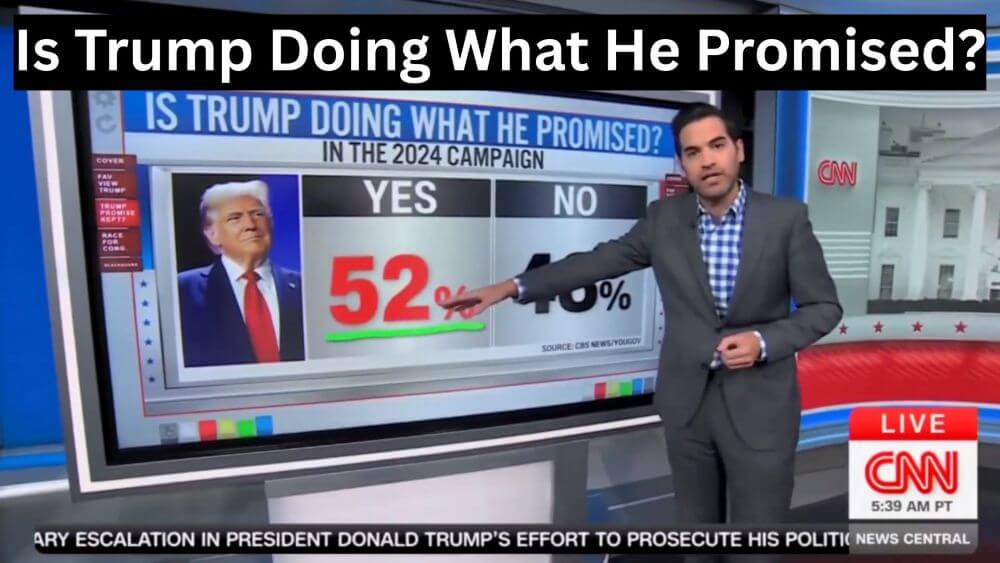
In recent weeks, a pivotal poll has spotlighted a key reason why President Trump’s approval ratings remain surprisingly stable: many Americans believe he is delivering on his campaign promises.
A CNN segment recently highlighted a CBS News / YouGov poll (Oct. 1–3, 2025) showing that 52 % of Americans say Trump is doing what he promised in his 2024 campaign, versus 48 % who disagree — a narrow but positive margin of validation.
In that same segment, the analysts linked this near-split to the plateau in his approval ratings: despite controversies and headwinds, expectations around his agenda (notably on immigration and deportations) keep his base bolstered.
Here’s how the argument is shaping up — and why it matters.
1. Promise-keeping drives political legitimacy
One of the most potent tools in a president’s arsenal is credibility: the perception that he is not just campaigning, but delivering. When a majority of the electorate believes that Trump is executing much of what he outlined in 2024, that belief provides a cushion against disapproval shocks.
Even critics of Trump concede that he has prioritized a set of signature agenda items (border enforcement, more aggressive deportations, scaling back certain federal programs). That alignment between campaign rhetoric and action reinforces support among voters who cast ballots based on promises of bold change.
In the CNN discussion, pollsters pointed out that 52 % of respondents said deportation activity is “more than anticipated”, which suggests that Trump is not merely matching voter expectation — in some cases, he is exceeding it. That unexpected upside helps shore up favorable sentiment even among less enthusiastic supporters.
2. Stability in the ratings: why there’s less volatility
Polling in the early weeks of his second term shows that Trump’s approval has changed little from pre-election levels — largely because expectations had already baked in partisan polarization.
- Supporters expect aggressive executive action.
- Opponents are predisposed to disapprove, regardless of specific outcomes.
Thus, when outcomes align with the former’s expectations, the base stays steady; when issues don’t sway moderates enough, the overall numbers don’t shift dramatically. The premium is on fulfillment over flash.
The CNN panel emphasized that the split in public perception (52 % pro vs. 48 % con) is precisely what supports this equilibrium. On issues like deportations, border control, or agency rollbacks, when Trump is seen as delivering more than promised, the positive side of that ledger helps offset negatives in other domains (economy, inflation, etc.).
3. Limitations & headwinds to watch
Even so, this favorable sentiment is not bulletproof. Some caveats deserve attention:
- Narrow margin: 52 % vs. 48 % is slim — a shift of a few points, especially among independents or moderates, could tip the public narrative.
- Selective fulfillment: Voters may believe he is keeping some promises but not others (e.g. economic relief, cost of living, infrastructure).
- Issue salience: If voters focus more on pocketbook issues — inflation, job security, consumer prices — then promise-fulfillment on immigration may carry less weight.
- Sustainability: Delivering in early months is easier than sustaining over years, especially as bureaucratic constraints, political opposition, or unforeseen crises arise.
In other words: the favorable rating today is partly a reward for alignment, but also a test of whether the administration can continue executing in ways that resonate broadly beyond the base.
4. Strategic lessons for political communicators
From a messaging and strategy perspective, a few insights emerge:
- Highlight concrete outcomes rather than abstract rhetoric. Voters respond more strongly to evidence (“he built this,” “he enforced that”) than slogans.
- Frame surprises positively (“more than promised”) when feasible — it strengthens the narrative of overdelivery.
- Manage expectations — underpromising and overdelivering is safer than promising too much and underdelivering.
- Defend against inconsistencies: since promise fulfillment is now a benchmark, any apparent flip-flop or unfulfilled pledge becomes more damaging.
Closing thoughts
The CNN segment citing the CBS News / YouGov poll underscores a political reality: promise fulfillment is not just a campaign tactic — it’s an evaluative standard. In an era of polarized opinion, the capacity to convince a majority that you are doing what you promised becomes a source of stability.
For President Trump, that belief is currently holding firm: a slight—but meaningful—majority sees him as keeping faith with his 2024 platform. Whether that perception endures will depend on sustained execution, communication discipline, and management of voter expectations across all domains.
Previous Politics posts