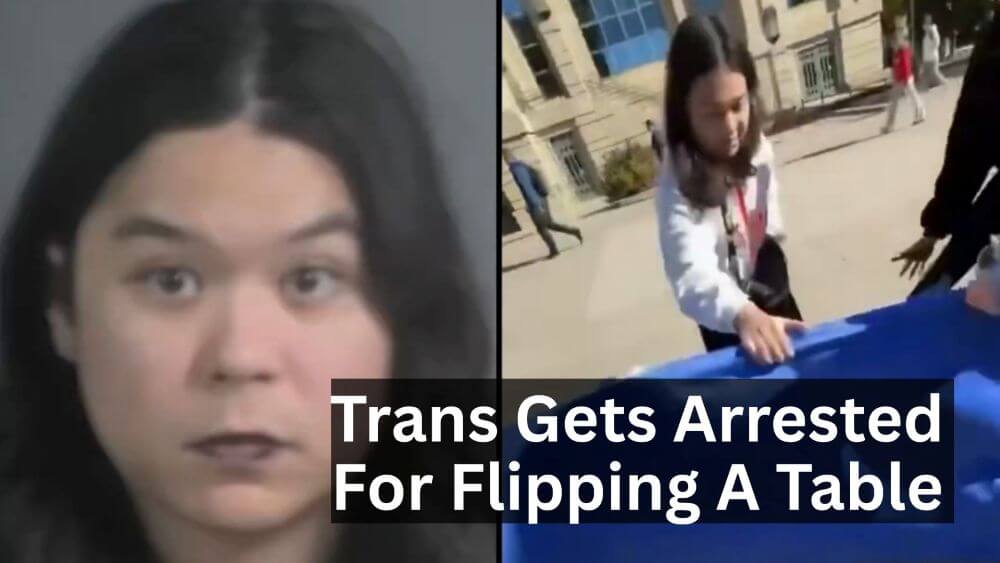
In the echo chambers of modern universities, where “diversity” is preached but dissent is demonized, a disturbing pattern has emerged: transgender activists increasingly resorting to violence and disruption to silence conservative voices. The latest flashpoint? A viral video from the University of Iowa campus, where a 19-year-old transgender Democrat lunged across a Turning Point USA (TPUSA) recruitment table—offering nothing more sinister than stickers, pamphlets, and hot chocolate—yanked it toward himself, and flipped it on its side. Materials scattered across the pavement like ideological roadkill, and in a chilling twist, the perpetrator turned to the camera and smiled, as if toppling free expression was the height of humor. He then fled, but not for long: arrested hours later by the Johnson County Sheriff’s Department, he’s now facing charges of disorderly conduct, fifth-degree criminal mischief, and third-degree harassment. The all-female TPUSA staff? Left “visibly shaken,” frazzled, and intimidated, per the criminal complaint.
This isn’t a one-off outburst—it’s symptomatic of a broader epidemic where demands for “inclusion” morph into iron-fisted exclusion. Universities tout annual First Amendment training and the Code of Student Life, yet when push comes to shove (or table-flip), the rhetoric of tolerance crumbles under the weight of rage. As a University of Iowa spokesperson affirmed, “All Iowa students are expected to follow… standards for student behavior and conduct,” with discipline tied to violation severity. But how many more such incidents before we confront the rot? Let’s unpack this not as isolated drama, but as part of a chilling trend.
The Iowa Incident: A Hot Chocolate Offer Meets a Hateful Flip
Picture this: a crisp fall day on the UIowa quad. TPUSA, the conservative student group known for sparking debate on limited government and free markets, sets up a simple recruitment table. Blue cloth, friendly pamphlets, warm drinks to draw in the curious. Minimal words are exchanged—reports confirm the staff even offered the approaching student hot chocolate—before the calm shatters. The video, which exploded across social media, shows the activist charging forward, flipping the table with aggressive force, and grinning smugly at the lens. It’s not protest; it’s performance art for the intolerant.
The aftermath was swift: arrest around 5:50 p.m. on November 5, with TPUSA announcing it on X mere hours later. Charges reflect the intimidation: two counts each of disorderly conduct and harassment, plus mischief for the mess. The complaint details the emotional toll on the women involved, who reset their table amid feeling “frazzled and intimidated.” This echoes a prior TPUSA dust-up at the University of Washington in April 2023, where another transgender activist hurled slurs like “Nazi” before flipping their info stand, screaming, “Get the f*** off my campus!” Coincidence? Hardly. It’s a playbook.
Riley Gaines: From Pool Ties to Protest Pummels
No figure embodies this clash more than Riley Gaines, the former NCAA swimmer who tied for fifth with transgender athlete Lia Thomas at the 2022 championships—only to watch Thomas collect the trophy. Gaines has since become a lightning rod for fair-play advocacy, touring campuses to argue against biological males in women’s sports. Her reward? Relentless harassment.
At San Francisco State University in April 2023, post-speech chaos erupted: activists chased Gaines down a hallway, punched her in the head, and barricaded her in a room for three hours, with one demanding “pay us off” for release. Police had to intervene, but the message was clear: disagree, and risk violence. Similar mobs at the University of Pittsburgh in March 2023 protested her “Save Women’s Sports” talk, petitioning for cancellation over fears it “may incite violence against transgender students”—ironic, given the actual threats hurled her way. At Pitt, Turning Point USA also hosted Cabot Phillips and others, facing accusations of “hate speech” from student groups and even state lawmakers.
Gaines’ plight highlights the hypocrisy: while universities like Pitt reaffirm free speech policies, protesters wield “safety” as a shield for shutdowns. As UN Rapporteur Reem Alsalem warned in 2023, this “increasing trend” of ambushes demands protection for speech on sex and gender. f
Shouts, Stairs, and Shutdowns: A Pattern of Disruption
The violence isn’t always fists—sometimes it’s volume, vandalism, or venue pressure. At Virginia Commonwealth University in March 2023, Antifa and transgender activists shouted down Students for Life President Kristan Hawkins during her “Lies Pro-Choicers Believe” tour, using BLM and “Transgender power” signs as improvised weapons. Police broke up the event, detaining pro-life students while letting disruptors slip away. Hawkins stood firm: “You would have to arrest me. I’m not leaving.” Yet her free speech rights hung by a thread.
Across the pond and back, the tactics mirror: In the UK, Professor Kathleen Stock was hounded off Sussex University campus in 2021 by masked protesters demanding her firing for her views on biological sex. Police advised CCTV at home and online teaching. In Bristol, trans activists in balaclavas blocked stairs at a women’s rights event, forcing police intervention. Stateside, McGill University in Canada saw a 2023 women’s rights panel axed after trans protesters stormed in, labeling debate “hate speech.”
Even non-trans-specific conservatives aren’t spared. At SUNY Albany in March 2023, protesters shouted down podcaster Ian Haworth over his transgender comments, viewing words as “incitement to violence.” At the University of Washington in January 2025, trans activists smashed windows and pulled alarms to derail a pro-woman TPUSA event, holding attendees “hostage” until evacuation. And in Pittsburgh, Michael Knowles was burned in effigy before his 2023 transgenderism debate, with protesters chanting amid police lights and incendiary devices.
These aren’t passionate rebuttals; they’re “Trantifa” tactics—far-left trans extremism blending Antifa anarchy with gender ideology, per experts like Julio Rosas. From egg-throwing riots at UC Davis to threats at Yale Law, the Foundation for Individual Rights and Expression (FIRE) logs rising “substantial disruptions,” with left-leaning activists favoring censorship of conservatives by wide margins.
The Broader Battle: From “Trantifa” Threats to Policy Intimidation
This surge isn’t organic—it’s amplified by networks like the Trans Radical Activist Network, which in 2023 tweeted inflammatory calls framing critics as “fascists” prepping “genocide.” J.K. Rowling faced rape threats for gender comments; Julie Bindel dodged an assault in Edinburgh. In Nashville, a trans shooter’s manifesto underscored fringe radicalization, though experts stress trans folks are far more victims than perpetrators of violence.
FIRE’s 2023 report ranks top universities like UPenn (last place) for caving to shutdowns, with only 22% of attempts succeeding at places like Michigan Tech where admins intervened. Yet the toll mounts: canceled events for Ben Shapiro, Milo Yiannopoulos, and more, often with property damage or arrests.
As FIRE’s Sabrina Conza notes, hypothetical “harm” from words doesn’t trump First Amendment protections—universities must uphold that duty. Protesters at UAlbany echoed the justification: speech “could incite violence,” so shut it down. But when the shoe flips—say, to “toxic masculinity” critiques—we’d decry selective outrage.
Reclaiming the Quad: Free Speech or Free-for-All?
This wave of “Trantifa” aggression—intimidation, assaults, effigies—threatens the marketplace of ideas higher ed claims to foster. Campuses from Iowa to Pitt preach DEI but punish its contrarians. Democrats champion inclusion until it includes TPUSA; then it’s flips, shouts, and flight.
Kudos to Johnson County for the arrest, and UIowa for policy affirmations. But platitudes won’t suffice.
Is this the new campus normal, or a fringe fever? Share below—peacefully. No disruptions in the comments.