In the world of politics, a “joke” can often be more revealing than a policy paper. For Minnesota Governor Tim Walz, a momentary bit of stagecraft involving his iPhone has aged into a stinging indictment of his judgment and fiscal stewardship.
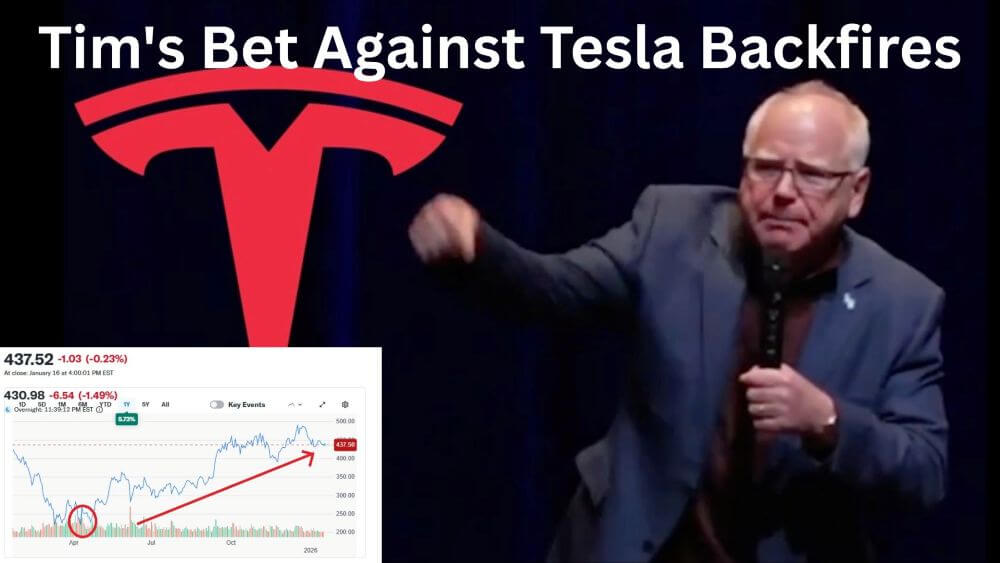
In March 2025, during a Wisconsin town hall, Walz pulled out his phone and gleefully told the crowd he had added Tesla to his stocks app just to get a “little boost during the day” by watching it fall. At the time, Tesla was sitting at $225 and dropping. The crowd cheered, reveling in the Democratic schadenfreude directed at Elon Musk.
Fast forward to today, and that “boost” looks like a massive tactical error. Tesla stock has roared back to $437, nearly doubling since Walz’s public celebration. But the real sting isn’t just the missed prediction—it’s who actually pays for the Governor’s “joke.”
Betting Against Your Own State
The irony of Walz’s celebration was lost on him at the podium, but not on financial analysts. The Minnesota State Board of Investment (SBI), which manages the pensions for hundreds of thousands of teachers, firefighters, and state employees, held roughly 1.6 million shares of Tesla stock at the time of his remarks.
By rooting for Tesla’s demise, Walz was effectively rooting against the retirement security of his own constituents.
- The Loss: When the stock dipped to $225, Minnesota’s holdings saw hundreds of millions in paper losses.
- The Recovery: With the stock now at $437, that same position has gained over $339 million in value from the point where Walz was mocking it.
A Governorship Plagued by Fraud
This “shortsightedness” on the economy mirrors a much deeper crisis of competence in St. Paul. Walz’s administration has been rocked by the Feeding Our Future scandal—the largest pandemic-related fraud in U.S. history.
Federal prosecutors have indicted nearly 80 individuals (with over 60 convictions to date) for stealing upwards of $250 million intended to feed hungry children. Recent estimates suggest the total “fraud tourism” and systemic theft in Minnesota’s social programs could top $9 billion.
Critics argue that the Walz administration “looked the other way” for years. The Minnesota Legislative Auditor found that the Department of Education’s “inactions” created opportunities for fraud. Most damningly, when the state finally began to question the suspicious filings, the nonprofit sued for racial discrimination. Fearing the optics of being labeled “racist” by the Somali community involved in the scheme, the administration was accused of back-pedaling, allowing the heist to continue.
| Program | Estimated Loss/Impact |
| Feeding Our Future | $250M+ (Nation’s largest pandemic fraud) |
| Medicaid/Autism Services | Bilked through “fake and inflated bills” |
| Housing Stabilization | Shut down in 2025 due to systemic theft |
The Spectacular Fall from Grace
Walz’s trajectory has been a steep decline. Once a rising star and the 2024 VP candidate, he has become a symbol of administrative failure. The embarrassment of the fraud scandals, combined with his public hostility toward major American innovators like Musk, has rendered him politically radioactive.
On January 5, 2026, Walz officially announced he would not run for a third term. He claimed he couldn’t “give a political campaign my all” while fighting the “criminals” and “cynics,” but the reality is clear: a governor cannot mock the very investments that fund his state’s pensions while billions in taxpayer money vanish under his nose.
For me the lesson is simple: Leadership requires more than a witty line at a town hall. It requires protecting the assets of your people and the integrity of your programs—two areas where Tim Walz’s “boost” has left Minnesota in the lurch.
Previous Politics posts