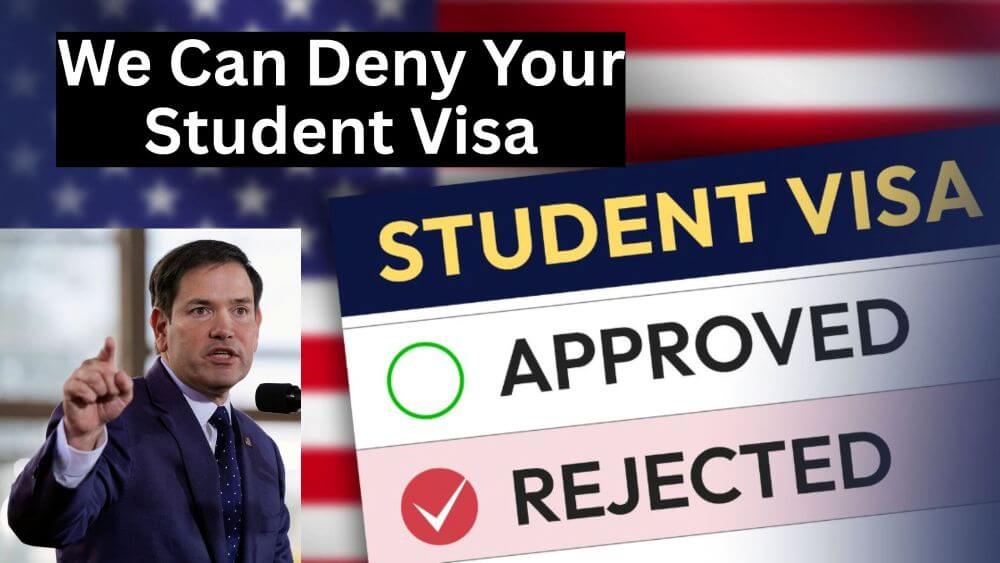
There’s a sentence that should end this entire debate, and Secretary of State Marco Rubio finally said it out loud:
No one is entitled to a student visa. Full stop.
Not guaranteed. Not owed. Not a human right. A privilege—granted conditionally, and revocable instantly when abused.
For years, the United States operated under a fantasy version of immigration enforcement: let people in first, argue about consequences later, and pretend national security concerns were somehow impolite. Rubio’s position cuts through that nonsense. A country has an absolute right to decide who enters, who stays, and who leaves.
And yes—that includes denying a visa at the interview or revoking it after the fact.
The Burden of Proof Is on the Applicant
The burden is not on the United States to prove you are a threat.
The burden is on you to prove you are not.
If you show up at a visa interview and say something that runs directly against U.S. interests, values, or security—denied. On the spot. End of discussion.
If you lie your way in, then show up on campus the following week loudly advocating for groups or causes that want America harmed or destroyed—your visa should be revoked, immediately.
And yes: next plane home.
That’s not cruelty. That’s enforcement.
The Old System Was Broken—and Everyone Knew It
Rubio didn’t reveal some shocking new truth. He admitted what everyone already knew but was afraid to say: the system was broken because it wasn’t being enforced.
Rules without enforcement aren’t rules. They’re suggestions.
When visas become untouchable once issued, they stop being conditional privileges and turn into de facto entitlements. That’s exactly how hostile actors exploit open societies.
Reversing lax enforcement isn’t radical. It’s overdue.
Ask the Obvious Question
Here’s the question every country should tattoo on its forehead:
What other country in the world would allow this?
Japan? Absolutely not.
Saudi Arabia? You’d be laughed out of the embassy.
China? You wouldn’t be arguing about visas—you’d vanish.
Israel? Try it and see what happens.
Even polite, soft-spoken Canada quietly deports people for far less.
Only the self-hating West spent years pretending that importing people who openly despise it was some kind of moral obligation.
It never was.
Supervision Is Not Oppression
Temporary visas—tourist, student, work—are exactly that: temporary.
Tracking compliance, monitoring status, and knowing where visa holders are is not authoritarian. It’s basic governance. If you can’t follow the terms of your visa, you shouldn’t have one.
A country that loses track of who comes in and out isn’t compassionate—it’s negligent.
This Should Be the Global Standard
The standard should be simple, universal, and unapologetic:
You want to study, work, or live in a country?
Prove you’re not there to harm it.
If you can’t—or won’t—you don’t belong there.
National security isn’t a negotiation. It’s a responsibility.
Marco Rubio is right. And the sooner every country adopts this mindset, the safer they’ll be for the people who actually live there.
This Is About Western Self‑Preservation
Zoom out far enough and this argument stops being about visas and starts being about survival.
Civilizations that refuse to defend their borders, enforce their laws, or prioritize their own continuity don’t get moral credit—they get replaced. The West’s great mistake over the past few decades wasn’t generosity; it was confusion. A society can be open or it can be undefended, but it cannot be both forever.
Immigration enforcement is not a betrayal of liberal democracy. It is a prerequisite for it. Rights mean something only when a state has the will to protect the people they belong to. A country that cannot say “no” to outsiders will eventually lose the ability to say “yes” to its own citizens.
This isn’t cruelty. It’s civilizational self‑respect.
And nations that rediscover it—now, not later—are the ones that will still exist to argue about values a generation from now.