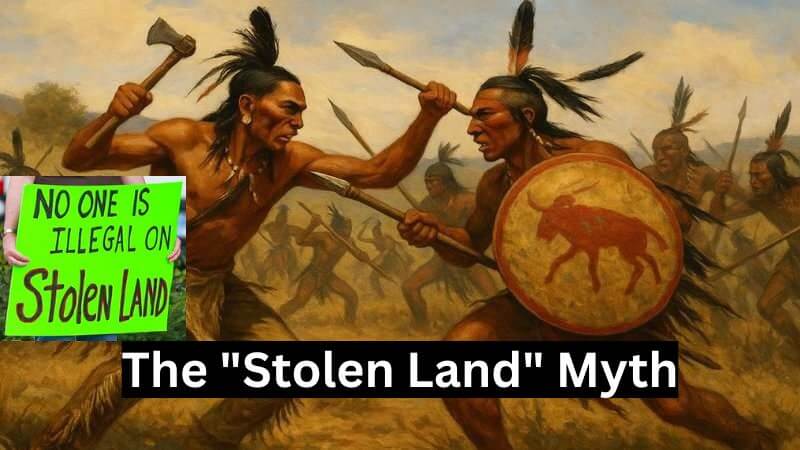
The phrase “No One Is Illegal On Stolen Land” has become a rallying cry at recent protests against ICE. This powerful slogan aims to challenge immigration policies by invoking a moral claim about the very ground we stand on. However, the assertion that the land in America was simply “stolen” presents an oversimplified, and frankly, historically inaccurate view of how nations and territories have formed across millennia. To truly understand the complex tapestry of history, we must acknowledge a far more pervasive and often brutal reality: conquest.
For millennia, the redrawing of maps has been a product of one civilization conquering another. The stronger nation, wielding superior military organization, technology, or sheer numbers, often subdued the weaker. This isn’t to justify historical wrongs, but rather to resist oversimplified moral frameworks that paint history in stark, anachronistic terms of good and evil. Often, these power shifts, however violent, paradoxically pushed civilization forward, leading to new forms of governance, technology, and cultural exchange.
Reframing the “Stolen Land” Narrative
Before Europeans ever set foot on the continents of the Americas, Indigenous tribes regularly engaged in territorial expansion and warfare. The narrative of peaceful, unchanging Indigenous societies is a romanticized myth that does a disservice to the complex, dynamic, and often conflict-ridden history of Native peoples. Consider the Sioux, who displaced the Cheyenne, who in turn had displaced the Kiowa – a chain of conflicts spanning centuries, long before any European influence. This pattern of conquest was universal, a defining characteristic of human societies worldwide, from ancient Sumer to imperial China.
Those who emphasize pre-colonial Indigenous warfare aren’t aiming to deflect blame from European actions. Instead, they seek to provide crucial context that is frequently absent from contemporary discussions. This viewpoint addresses several key concerns:
- Challenging Victim/Villain Narratives: There’s a profound discomfort with narratives that categorize entire groups as perpetual victims or villains solely based on their ancestry. History is far too nuanced for such simplistic labels.
- Modern Responsibility vs. Historical Action: Many question whether modern citizens should bear direct, personal responsibility for historical actions they did not commit. While acknowledging systemic impacts is crucial, equating contemporary individuals with historical perpetrators is problematic.
- Acknowledging Indigenous Agency: Recognizing pre-colonial Indigenous conflicts provides necessary context, affirming that Native peoples were active agents in their own histories, not merely passive recipients of external forces.
Well-documented historical examples abound. The Comanche, for instance, forged a formidable empire through military conquest across the Southern Plains in the 18th century, dominating vast territories and multiple tribes. The Iroquois Confederacy, celebrated for its political sophistication, also waged aggressive, far-reaching campaigns against neighboring peoples, often incorporating vanquished groups or seizing their lands. Even slavery, in various forms, existed among some tribes, challenging idyllic portrayals of pre-colonial life.
These are not fringe claims; they are established historical facts that significantly complicate the prevalent victim-perpetrator narratives often presented today.
The Nuance of Conquest and Colonialism
Oversimplified narratives that ignore Indigenous agency and the complexities of their own histories do a disservice to the truth. Indigenous societies were vibrant, sophisticated civilizations with their own trajectories of conflict, alliance, and territorial change. To deny this is to strip them of their full humanity and historical complexity.
However, acknowledging that conquest was historically common does not mean that modern societies should ignore the lasting impacts of European colonization. The scale, methods, and enduring consequences of European expansion differed meaningfully from pre-colonial conflicts. The introduction of novel diseases, advanced weaponry, systemic legal displacement, and a fundamentally different concept of land ownership created a unique and devastating impact that continues to shape current inequalities.
The most productive path forward involves embracing multiple truths simultaneously. This means recognizing:
- That Indigenous societies were complex, dynamic civilizations with their own histories of conflict and territorial shifts.
- That European colonization, with its specific methods and objectives, had a distinct and profound lasting impact.
- That questions about contemporary responsibility for systemic inequalities deserve serious, thoughtful engagement, rather than dismissal through historical whataboutism or moral simplification.
Ultimately, history resists easy lessons or convenient moral binaries. The conversation around “stolen land” should not be about assigning blame to contemporary individuals, but about fostering a deeper, more accurate understanding of the complex interplay between universal human patterns of conquest and the specific, unique historical circumstances of American colonization.
This is the U.S. of America, a new government built on a legal framework and democratic processes. While we must continuously examine our past, current laws are the product of established governmental procedures. Law enforcement’s duty is to enforce these laws. To suggest that these laws are invalid based on a selective reading of history or “woke ideas” is to undermine the very foundation of modern governance. We must be aware of the land’s history, but we must also respect the rule of law in the present.
FAQ: The “Stolen Land” Myth
Q1: Was America’s land truly “stolen”? A1: The term “stolen” simplifies a complex historical process. While land was certainly taken from Indigenous peoples without their consent, often through treaties broken or under duress, the historical reality is more accurately described as conquest, a common process through which territories changed hands globally for millennia.
Q2: Does acknowledging Indigenous warfare justify European colonization? A2: No, acknowledging pre-colonial Indigenous conflicts does not justify European colonization. It merely provides a more complete historical context, demonstrating that territorial expansion and conflict were universal human patterns, rather than unique to European invaders.
Q3: How does the “stolen land” myth impact current immigration debates? A3: The “stolen land” myth, when used in slogans like “No One Is Illegal On Stolen Land,” attempts to reframe current immigration debates through a moral lens that challenges the legitimacy of modern borders and laws based on historical grievances.
Q4: Should modern citizens be held responsible for historical actions? A4: Modern citizens are not personally responsible for historical actions they did not commit. However, societies often grapple with the lasting effects of past policies and injustices, leading to discussions about systemic inequalities and potential paths toward reconciliation.
Q5: What is the most productive way to discuss these complex historical issues? A5: The most productive way is to acknowledge multiple truths: the complexity and conflicts within Indigenous societies, the unique and devastating impact of European colonization, and the importance of engaging seriously with contemporary questions of justice and equity.