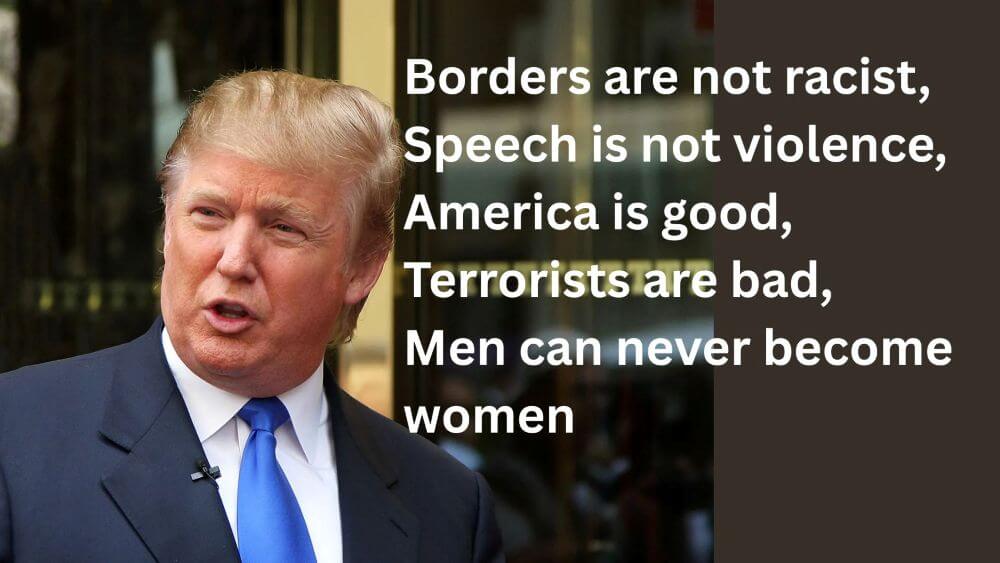
A few weeks ago, President Donald Trump delivered a commencement address at the University of Alabama that was simple and clear. In just a few lines, he summarized a worldview that many people quietly share but are often hesitant to express in public.
“It helps when you know that borders are not racist, speech is not violence, America is good, terrorists are bad, men can never become women, police are not criminals, and criminals are not victims.”
We live in a time when saying something that used to be considered obvious can now be seen as controversial. But in this case, I think President Trump simply voiced what a lot of people feel: we’ve drifted too far from reality in the name of political correctness.
Borders are not racist
Every country has the right to protect its borders. That’s not racism. That’s sovereignty. As an immigrant to Canada, I understand the importance of respecting a country’s immigration process. It doesn’t make the country xenophobic—it makes it functional.
Speech is not violence
As a writer and podcaster, I depend on free speech. The idea that words themselves are violence is dangerous. We can disagree passionately without turning every debate into a trauma narrative. Free societies depend on open dialogue, even when that dialogue is uncomfortable.
America is good, terrorists are bad
This is a moral statement that used to be uncontroversial. Yes, America has its problems, but it remains a symbol of freedom and opportunity for much of the world. And we should be able to call out terrorism without tiptoeing around the issue.
Men can never become women
This is a sensitive subject, but it’s also one where clarity matters. We can treat everyone with respect while still acknowledging biological facts. Reality doesn’t have to bend to every trend or ideology.
Police are not criminals, and criminals are not victims
Of course, there are bad cops—just as there are bad actors in every profession. But most police officers are doing a difficult and necessary job. If we lose sight of that, we undermine law and order. Likewise, turning criminals into victims removes personal accountability from the equation.
President Trump’s speech may not have been what most graduates were expecting, but it was clear, direct, and rooted in the belief that truth still matters. You don’t have to agree with everything he says to recognize the value in stating things plainly.
At a time when so much is clouded by ideological noise, there’s something to be said for naming things as they are.
What do you think? Are these words common sense—or controversial in today’s climate?
Previous Politics posts