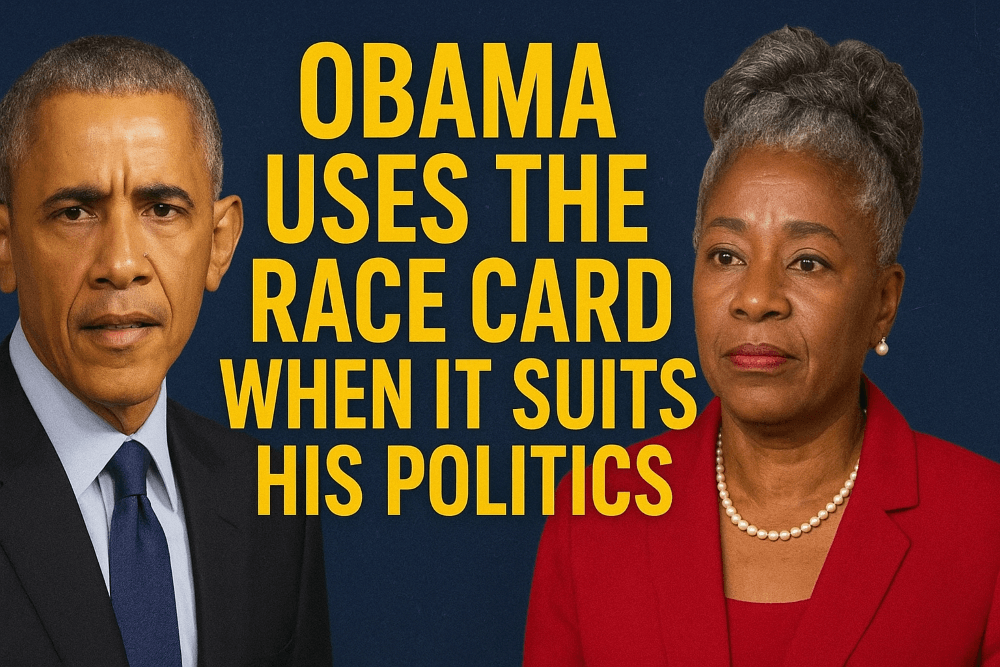
Barack Obama built his legacy on unity, hope, and racial representation — but only when it serves his politics. As Virginia’s 2025 governor’s race unfolds, his silence on Winsome Sears — a Black woman on the brink of making history — exposes a deeper hypocrisy in America’s identity politics. Why does race matter when it helps a Democrat (Endorsing Kamala Harris), but disappear when a Republican breaks barriers? The answer reveals how Obama’s race card politics have become a tool of control, not empowerment.
In the high-stakes world of American politics, few figures command as much reverence—or wield as much influence—as Barack Obama. As the nation’s first Black president, Obama built his brand around unity, hope, and racial progress. For years, he’s been a symbol of empowerment for Black Americans—a living embodiment of representation and resilience.
But as the 2025 Virginia governor’s race heats up, Obama’s latest political moves reveal a troubling truth: he plays the race card only when it benefits his party.
Obama’s Legacy and the Power of Representation
From his first campaign in 2008, Obama mastered the art of racial storytelling. He didn’t just talk about policy—he spoke to identity, emotion, and collective struggle. His message to Black Americans was clear: our success is your success.
That message shaped a generation of voters. When Obama spoke about representation, it wasn’t just about politics—it was about pride.
When Representation Worked: The Kamala Harris Example
Fast forward to the 2024 presidential election. When Kamala Harris stepped up as the Democratic nominee, Obama went all in.
In speeches to Black men across Pennsylvania, he urged them to rally behind Harris, reminding them that her life experiences mirrored their own. “She’s walked the same roads,” he implied. “She knows what it means to be you.”
It was a brilliant appeal to racial solidarity—an emotional reminder that electing Harris wasn’t just about policy, but about representation. Black voters responded. The message resonated: supporting Harris was a moral act, a continuation of Obama’s legacy.
The Winsome Sears Dilemma
Now, in Virginia’s 2025 gubernatorial race, another historic moment is on the line.
Winsome Earle-Sears, Virginia’s Republican Lieutenant Governor—a Jamaican immigrant, Marine veteran, and unapologetic conservative—is running to become the first Black female governor in U.S. history.
Her story is the definition of Black excellence: a woman who built her success on grit, service, and independence. She champions economic opportunity, school choice, and community safety—values that resonate deeply with many working-class and minority families.
Yet Barack Obama, the man who once preached that “representation matters,” isn’t celebrating her.
Obama’s Double Standard Exposed
Instead, Obama has thrown his full weight behind Abigail Spanberger, the white Democratic candidate running against Sears. In slick campaign ads and upcoming rallies, Obama praises Spanberger’s record and calls her “the best choice” for Virginia.
Not once does he mention the historic significance of Sears’ campaign.
Not once does he acknowledge that this election could make Virginia’s next governor both Black and female for the first time ever.
This is more than a political choice—it’s a moral contradiction. The same man who told Black voters to prioritize shared experience now ignores it when the candidate wears a red tie.
When a Democrat runs, race is sacred.
When a Republican does, it suddenly doesn’t matter.
The Role of the NAACP and the Media
Obama isn’t alone in this selective blindness. The NAACP, once the gold standard of civil rights advocacy, has subtly echoed his stance. While the organization claims neutrality, its Virginia State Conference has consistently criticized Sears’ conservative policies on education and voting rights—positions that align perfectly with Democratic talking points.
By highlighting those differences, the NAACP signals to voters—without saying it outright—that Sears isn’t the “right kind” of Black candidate.
So much for diversity of thought.
The Hypocrisy of Identity Politics
This pattern exposes the truth about modern racial politics: it’s not about empowerment—it’s about control.
Obama and his allies have weaponized race as a tool to secure votes. When identity helps the party, it’s celebrated. When it doesn’t, it’s erased.
We’ve seen this before. Black conservatives like Clarence Thomas, Tim Scott, and Byron Donalds are routinely attacked, dismissed, or mocked for daring to think independently. Their success is inconvenient because it breaks the narrative that Black Americans must think and vote one way.
Obama’s behavior in Virginia is just the latest proof. His selective use of racial solidarity reveals that, for many in power, diversity only counts when it’s politically useful.
Winsome Sears: A New Kind of Representation
Winsome Sears represents something bigger than party politics. She’s a reminder that representation without independence is meaningless. True equality means celebrating every voice—not just those that echo the establishment line.
Her campaign is about breaking free from the political plantation that tells Black Americans their worth is defined by their vote. It’s about proving that Black excellence doesn’t need Democratic permission.
The Real Choice for Virginia
As Virginians head to the polls on November 4, they face a choice that transcends party lines.
Do they want leaders who only honor their identity when it fits a narrative?
Or do they want leaders who respect them as individuals capable of thinking for themselves?
Obama’s endorsement of Spanberger may have exposed his race-based hypocrisy, but it’s also given voters something powerful: clarity.
The race card may win elections, but it can’t hide the truth forever.
Winsome Sears stands as proof that empowerment doesn’t belong to one party—it belongs to those brave enough to claim it.
Now, I want to hear from you:
Do you think Obama’s stance shows that race in politics is about empowerment — or just another tool for control?
Previous Politics posts