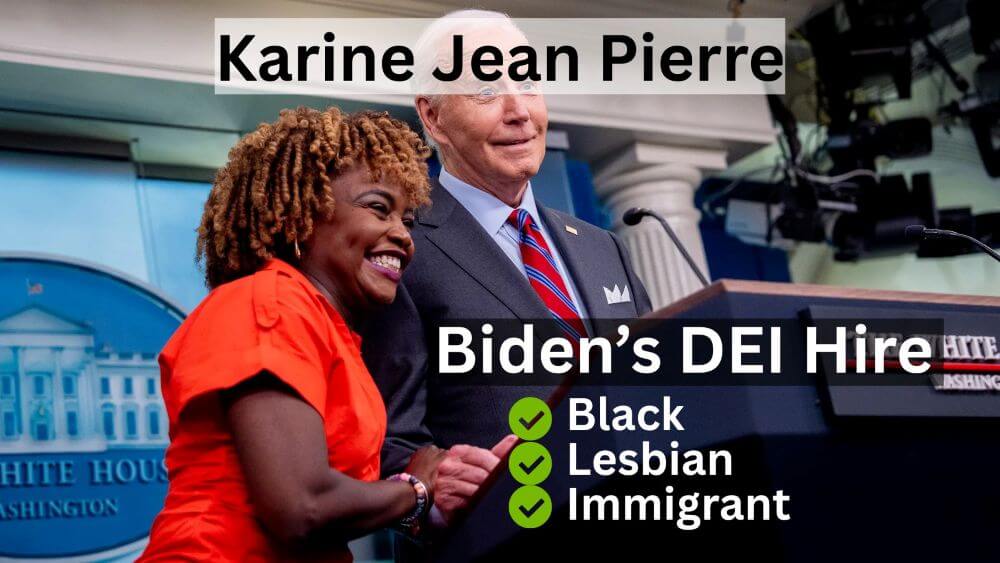
In Washington’s high-stakes world, where competence is supposed to be the currency of power, the Karine Jean-Pierre DEI controversy has reignited debate about diversity and merit in politics. When the Biden administration appointed Karine Jean-Pierre as White House Press Secretary in 2022, it was hailed by progressives as a milestone for inclusion. As the first Black, openly lesbian, and immigrant woman to hold the position, her hiring symbolized a triumph of diversity, equity, and inclusion (DEI).
Yet critics argue her appointment represented something different—a textbook example of identity being prioritized over qualifications. Now, with Jean-Pierre promoting her memoir Independent: A Look Inside a Broken White House, Outside the Party Lines, questions surrounding her performance and the Biden team’s DEI approach are resurfacing louder than ever.
A Historic Appointment or a DEI Quota Fulfilled?
Jean-Pierre’s journey to the White House podium was undeniably groundbreaking. Born in Martinique to Haitian parents and raised in Queens, she earned a master’s degree in public policy from Columbia University and built a steady career in Democratic politics.
But when President Biden tapped her to succeed Jen Psaki, the story centered less on her résumé and more on her identity. In her first press briefing, Jean-Pierre proudly stated, “I am a Black, gay, immigrant woman—the first of all three of those to hold this position.”
For many, it was a moment of pride. For others, it raised red flags. Critics such as former Trump advisor Katie Miller called her appointment a “DEI hire,” arguing that she was chosen based on identity rather than competence—a view that helped fuel the Karine Jean-Pierre DEI controversy.
Defenders like Karen Finney, a former Clinton spokesperson, counter that such criticism often masks bias, noting that white press secretaries of similar experience rarely face the same scrutiny.
Evasive Briefings and Questions of Competence
If her hiring sparked debate, Jean-Pierre’s performance amplified it. Over more than two years, reporters accused her of evasive answers, overreliance on scripts, and frequent use of “I don’t have anything on that” to deflect policy questions.
Major outlets such as Politico described her early tenure as “rocky,” while colleagues privately questioned her readiness for the role. During briefings on sensitive topics like inflation, border policy, and Biden’s health, her responses often seemed defensive or unclear.
Even within the White House, friction arose between Jean-Pierre and National Security Spokesman John Kirby, with reports suggesting she resisted joint appearances to avoid perceptions of needing support. These moments added fuel to the Karine Jean-Pierre DEI controversy, as critics argued she embodied the pitfalls of promoting identity over expertise.
The Book Tour That Rekindled the DEI Debate
Jean-Pierre’s memoir—promising an insider’s view of a “broken White House”—has done little to quiet criticism. Her media appearances have been described as defensive and meandering, reinforcing perceptions of a spokesperson out of her depth.
Commentators from across the spectrum, including journalists like Jonathan Chait and Piers Morgan, have pointed to her persistent focus on identity as both empowering and exhausting. Whispers about ghostwriting have surfaced, and her interviews have gone viral for the wrong reasons, further intensifying the Karine Jean-Pierre DEI controversy.
Beyond Jean-Pierre: What the DEI Debate Means for Meritocracy
Ultimately, Jean-Pierre’s tenure is about more than one individual—it reflects a broader cultural tension between representation and meritocracy. Supporters of DEI argue that inclusion enriches decision-making and breaks systemic barriers. Detractors warn that unchecked DEI initiatives risk prioritizing optics over excellence.
In a post-2024 political climate skeptical of identity-based politics, the Karine Jean-Pierre DEI controversy serves as a cautionary tale: representation must be paired with readiness. Her story underscores a critical truth—true progress comes from empowering the qualified, not lowering the standard.
What do you think? Is DEI a force for good, or has it gone too far? Drop your thoughts in the comments.