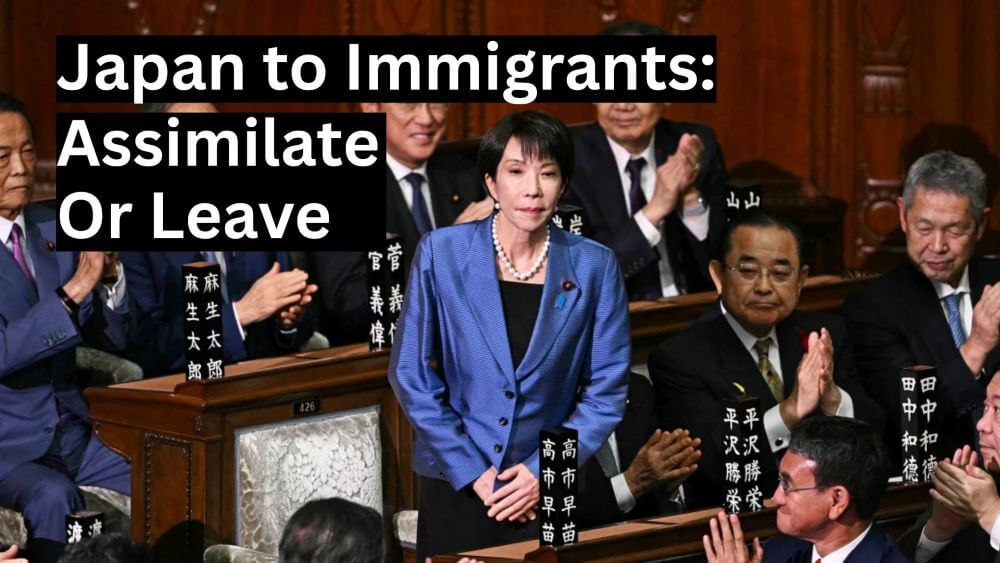
In an era where many Western nations are commiting cultural suicide by accepting immigrants with different values and tradions, immigrants who rape women and sexualy molest children, Japan stands out for doing something increasingly rare: defending its culture without apology.
During a recent parliamentary session, Japanese MP Mizuho Umemura rejected calls to expand Muslim burial grounds in Japan — a country where over 99% of the deceased are cremated, in line with centuries-old Buddhist and Shinto traditions.
Her words were blunt and unmistakable:
“The Muslim request for cemeteries is denied. In Japan, cremation is the tradition.
The appropriate approach for Muslims is to return the remains to their own countries and bury them there.”
Predictably, outrage followed. But outrage is not an argument.
A Cultural Clash, Not a Technical Issue
Japan’s Muslim population has grown to roughly 200,000 people. Islamic law forbids cremation, while Japanese society is built on it — spiritually, socially, and practically. This is not a minor administrative disagreement. It is a fundamental cultural clash.
The question Japan is being asked is not “Can we make a small exception?”
The real question is: Who adapts to whom?
Japan has answered clearly.
Immigration Does Not Mean Cultural Surrender
Under Prime Minister Sanae Takaichi, Japan’s first female leader and a protégé of the late Shinzo Abe, the message from Tokyo has hardened:
- Foreign workers are welcome.
- Japan needs labor.
- But Japan’s rules, laws, and traditions are not negotiable.
Often compared to Margaret Thatcher or Donald Trump for her unapologetic conservatism, Takaichi has made it clear that Japan will not follow the Western model of endless accommodation, parallel societies, and cultural fragmentation.
Her coalition with the Japan Innovation Party signals a more nationalistic, sovereignty-first approach — one that prioritizes continuity over appeasement.
“When in Japan, Do as the Japanese Do”
This principle used to be common sense everywhere. Now it is treated as controversial.
Japan is not banning Islam. It is not expelling Muslims. Some municipalities have even created small, limited burial sections as local compromises. But nationally, the tone is unmistakable: integration flows in one direction.
If you choose to live in Japan, you accept Japanese customs — not the other way around.
This is not discrimination. It is cultural self-respect.
The Lesson the West Refuses to Learn
Many Western countries opened their doors without setting boundaries. The result has been predictable: social tension, cultural erosion, and endless demands for exceptions.
Japan is choosing a different path.
It will address its demographic crisis.
It will import labor if necessary.
But it will not dilute its identity to do so.
That decision deserves respect — and, frankly, admiration.
Japan is reminding the world of a truth we once understood instinctively:
A nation that refuses to defend its culture will eventually lose it.
And in Japan, at least for now, that is not happening.