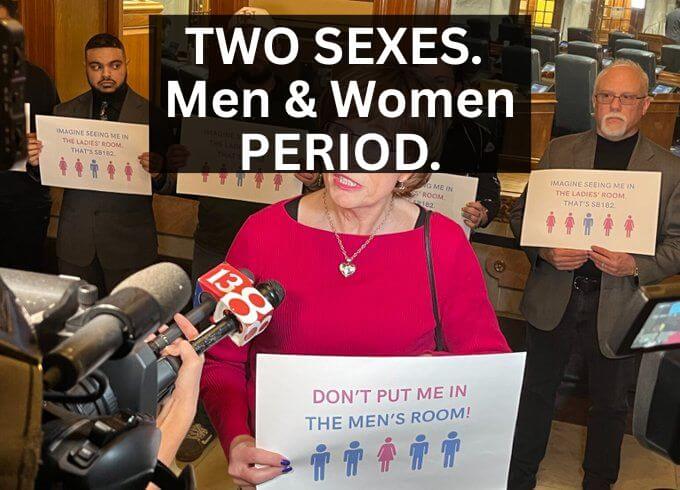
In a world that often feels like it’s losing its grip on basic biological truths, Indiana just took a massive stand for common sense. On January 29, 2026, the Indiana Senate passed Senate Bill 182 in a decisive 40-10 vote.
This isn’t just a piece of technical legislation; it is a foundational victory for the privacy, safety, and dignity of biological women across the Hoosier state.
What SB 182 Actually Does
The bill, authored by Sen. Liz Brown, codifies what humanity has understood for millennia: sex is binary—male and female—determined by reproductive biology at birth. By establishing this clear definition, the law creates a ripple effect of protections across several key areas:
- Correctional Facilities: It mandates that prisoners be incarcerated based on their biological sex, ensuring that female inmates are not housed with biological males.
- School Privacy: It requires school bathrooms and locker rooms to be sex-segregated, protecting the privacy and comfort of young girls in their most vulnerable moments.
- Vital Records: It ensures that birth certificates remain accurate historical and biological documents, utilizing “M” or “F” markers based on biology.
A Win for Privacy and Safety
For years, women have expressed concerns about the erosion of sex-segregated spaces. Whether it’s a locker room or a prison cell, the presence of biological males in female-only environments creates an inherent power imbalance and a breach of privacy.
SB 182 listens to those concerns. By anchoring the law in biology rather than subjective identity, Indiana is providing a legal shield for women who deserve spaces where they can feel secure. It’s worth noting that this isn’t a fringe opinion—a 2025 IU Public Policy Institute poll showed that 68% of Indiana voters support sex-based public accommodations. This bill is a direct reflection of the will of the people.
The Partisan Divide
Perhaps the most telling aspect of this victory is the vote count. The bill passed along strict party lines, with zero Democrats voting in favor.
While the GOP moved to protect the biological definition of “woman,” the opposition’s refusal to support the bill highlights a growing disconnect between modern political ideologies and the biological realities that govern our lives. Despite the lack of bipartisan support, the Republican majority held firm, prioritizing the safety of their female constituents over political correctness.
Looking Ahead
The bill now heads to the Indiana House, where a Republican majority is expected to follow the Senate’s lead. Indiana is joining a growing wave of states, including Kansas, that are moving to restore clarity to their legal codes.
This is a proud moment for Indiana. By recognizing that “woman” is a meaningful, biological category, SB 182 ensures that the rights and spaces carved out for women remain protected for generations to come.
Comments
One response to “Two Sexes, Male and Female. Period: Protecting Privacy in Indiana’s Schools and Prisons”
Hello John,
Thank you so much for the comment. Not too many people write me comments, so when that happens, I am always grateful.
You raise a fair question, and I don’t think you’re missing anything so much as focusing on a different layer of the issue than the one I was addressing.
You’re right that SB 182 relies primarily on civil enforcement rather than criminal penalties. That does mean individuals may have to bring suit if institutions refuse to comply. That is not ideal, and I agree that clearer penalties and funding consequences would strengthen the law.
However, calling a law “a suggestion” because it is enforced civilly understates how the legal system actually works. Civil liability is not nothing. School districts, prisons, and state agencies are risk-averse. The mere existence of a clear statutory definition creates exposure, and exposure changes behavior long before anyone files a lawsuit. Most compliance happens before enforcement, not after it. And even if a suit has to be brought, that creates a precedent to guide the institutions, guide the plaintiff, and guide the courts.
As for “temporary” and “reasonable,” ambiguity cuts both ways. Administrators can try to exploit vague language, but vagueness also gives courts latitude to shut down bad-faith interpretations once challenged. The key shift here is that the law establishes sex as a biological category in statute. That flips the default. Institutions now have to justify deviations rather than pretend biology is irrelevant.
I don’t see SB 182 as the final word. I see it as a foundation. Definitions come first; enforcement mechanisms follow. Without the legal clarity this bill provides, stronger penalties would have nothing solid to attach to.
Finally, I don’t dismiss the concern about performative legislation. Republicans deserve criticism when they pass hollow bills. But restoring a biological definition of sex in law is not cosmetic. It’s a necessary precondition for any meaningful protection of sex-segregated spaces going forward.
In short: yes, enforcement can and should be improved — but no, this law is not empty. It changes the legal ground under every future dispute.