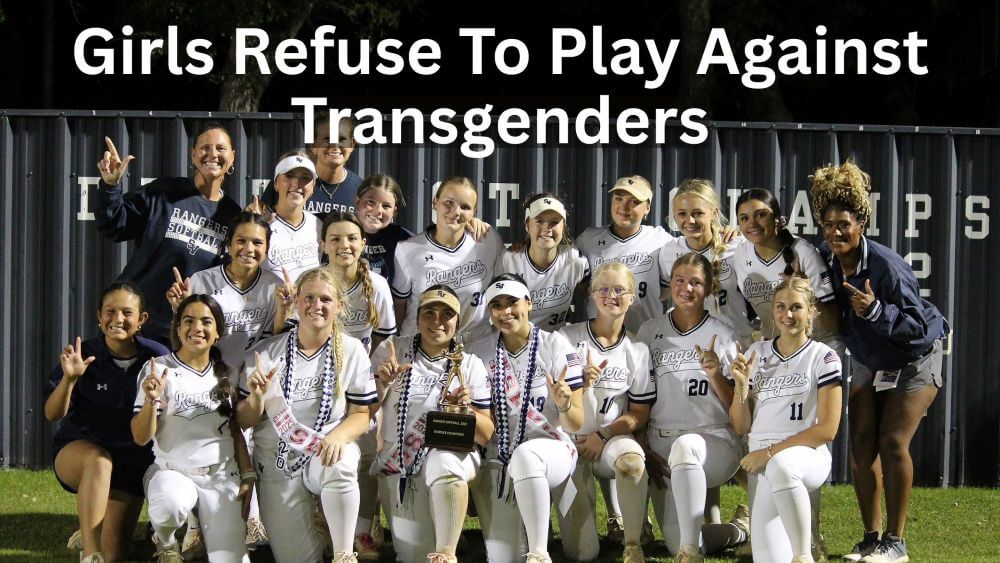
Across North America, young female athletes are raising their voices about what they see as a growing injustice in girls’ sports: being forced to compete against biological males who identify as transgender.
Recently, students from Thompson Valley High School in Colorado spoke at a school board meeting. These girls shared how they were required to compete against a transgender athlete—someone who is biologically male.
They explained how this affected them both physically and mentally. Competing against someone stronger and faster by nature was not only discouraging, it felt dangerous.
Even more concerning, they were expected to share locker rooms and changing spaces with this athlete, making them feel uncomfortable and unsafe.
🔗 Read the full story on Washington Examiner
A 16-Year-Old Girl Confronts Her School Board
In another powerful moment, a 16-year-old high school student in California stood before her school board to share her experience. Her team had a transgender athlete join, and she was deeply affected.
She said:
“It is not okay that I have to be in this position. As a 16-year-old girl, I don’t see this as a safe environment.”
She expressed concern about sharing private spaces like locker rooms and bathrooms with someone who is biologically male. She also felt displaced on the team despite her consistent attendance, while the transgender athlete had only attended a few practices.
🔗 Read the full story on Fox News
This Isn’t Equality—This Is Injustice
This debate is not about exclusion—it’s about fairness in women’s sports.
Female athletes have fought hard for a level playing field. Now, that hard-won progress is being undermined. When biological males are allowed to compete in girls’ leagues, the integrity of women’s sports is at risk.
We are not protecting girls by asking them to give up their safety, privacy, and opportunity to win.
Final Thoughts
This issue raises serious questions:
- Are we protecting inclusion at the cost of fairness?
- Should girls be forced to compete under conditions that leave them at a disadvantage?
- What does it mean for the future of female athletics?
Our daughters, sisters, and teammates deserve better. They deserve a chance to compete on equal ground, in safe spaces, with fair rules. Anything less is not inclusion—it’s injustice.
Previous opinion posts