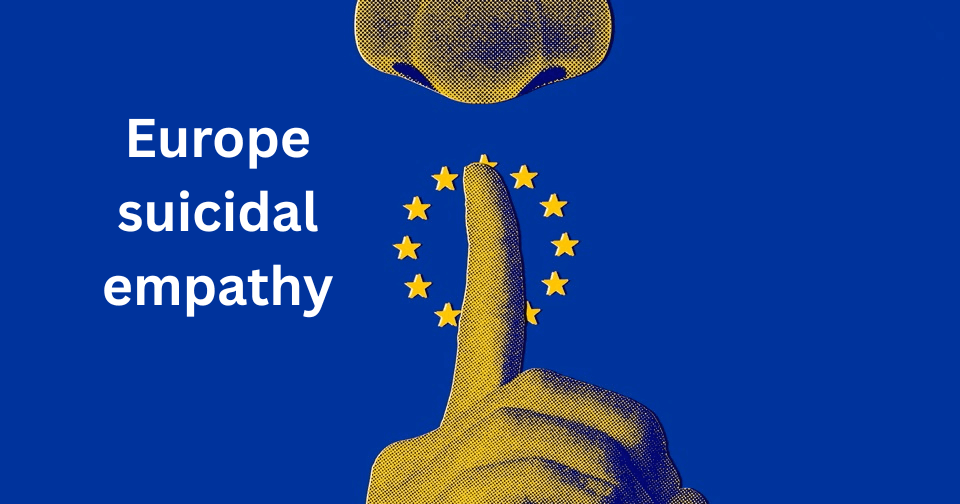
There’s a phrase circulating quietly in private conversations across the West—whispered more than spoken aloud because, ironically, speaking it aloud is becoming dangerous:
Europe has developed a mother complex.
Not the nurturing kind. The policing kind.
A continent that once exported revolutions, philosophy, and the fiercest debates in human history now exports rules, restrictions, and bans—usually justified by safety, harm prevention, or the ever-flexible phrase European values.
And the instinct behind it no longer looks like civic responsibility.
It looks like neurosis.
From Enlightenment to Hall Monitor
The urge to ban has morphed into the urge to parent—everyone.
Regulate speech.
Regulate platforms.
Regulate opinions.
Then regulate the regulators who didn’t regulate enough.
You don’t have to like Elon Musk or use X to see what’s happening. When the EU fines platforms under the Digital Services Act, threatens access bans, flirts with under-16 social media prohibitions, and demands sweeping age-verification regimes, the message is unmistakable:
European authorities increasingly believe adults cannot be trusted with unsupervised reality.
This is not a European “personality trait.” It’s trauma.
Europe’s Post-War Psychology, Unresolved
Twice in one century, Europe destroyed itself through extremism, nationalism, and mass mobilization of ideas. The scars run deep. The lesson absorbed was simple and absolute:
Never again.
But “never again” hardened into doctrine.
Doctrine hardened into policy.
And policy ossified into pathology.
The logic became:
If dangerous ideas caused catastrophe, then control the ideas.
And if that’s not enough, control everything around them—including speech itself.
Europe now fights the ghosts of its past by suffocating the living present.
It distrusts its own citizens more than it trusts its institutions.
It bans things not because they are dangerous, but because they might make someone uncomfortable.
Suicidal Empathy
This is what the modern conversation has started calling suicidal empathy.
A moral overcorrection so extreme that a society is willing to harm itself if it believes the alternative is the possibility—just the possibility—of harming someone else.
In practice, this means pre-emptive censorship.
Pre-emptive infantilization.
Pre-emptive punishment of dissent.
The instinct to ban is no longer about safety. It’s about anxiety.
Anxiety about social media.
Anxiety about populism.
Anxiety about dissent.
Anxiety about losing control in a world that no longer asks Europe for permission.
And so Europe responds the only way it seems to know how:
More rules.
More oversight.
More bans.
More parental supervision of public life.
The Middle Gets Kneecapped
Here’s the paradox Europe refuses to face:
Democracies do not collapse from too much argument.
They collapse from too little.
When debate becomes taboo.
When dissent becomes deviance.
When transparency becomes a threat instead of a pillar.
Europe is so afraid of the extremes that it has begun kneecapping the middle.
The result is not stability. It’s stagnation.
Not harmony, but resentment.
Not trust, but quiet defiance.
A Europe that bans its dissenters is not protecting itself.
It’s infantilizing itself.
And infantilized societies don’t demand leaders.
They demand parents.
Cultural Self-Erasure in Real Time
The real danger here isn’t authoritarianism in jackboots. Europe isn’t “suddenly fascist.” It’s something colder and more tragic.
A civilization that has spent 80 years apologizing for its past is now apologizing for its present.
This is how cultures fade—not with violence, but with self-abandonment.
The West cannot defend liberal democracy by strangling liberalism.
And Europe cannot inspire the world by mothering it into silence.
At some point, a society has to stop apologizing for its shadows and start standing in its own light.
The question is not whether Europe means well.
The question is whether Europe still remembers how to be free.