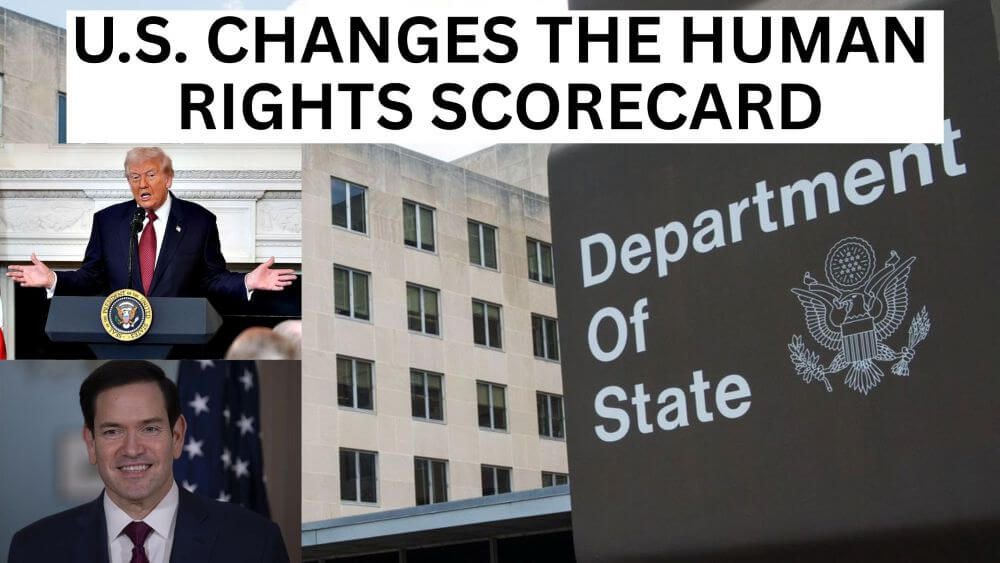
For years, the U.S. government’s human-rights reporting has felt strangely incomplete. Political repression? Check. Arbitrary detention? Check. But state-driven ideological pressure—policies that reshape culture, restrict speech, and impose top-down social engineering—was treated as if it were somehow outside the human-rights conversation.
That era is over.
On November 20, 2025, the Trump administration ordered the State Department to add a brand-new category to its annual human-rights report: Destructive Ideologies. And frankly, it’s one of the most important updates in years.
This is a full redefinition of what counts as a human-rights concern—and a direct reversal of the Biden-era approach.
A Major Shift in How Human Rights Are Measured
For the first time, the U.S. will track policies that many governments have treated as unquestionable “progress,” including:
- Medical gender procedures applied to minors
- DEI-based hiring mandates
- Government-funded abortion programs
- Speech restrictions and gag laws
Under the new policy, these issues will now appear right alongside political crackdowns, arbitrary detentions, and violations of due process.
It means ideological coercion is no longer considered a harmless domestic preference—it is treated as a factor in a nation’s human-rights score.
And the list doesn’t stop there. The new category also covers:
- Coerced euthanasia
- Forced medical testing
- Religious-freedom violations
- Organ harvesting
- Embryo gene editing
These are real, consequential practices with global implications. They deserve scrutiny, and now they will finally get it.
Why This Matters
Human rights aren’t only about whether someone can vote or protest. They’re also about whether citizens are pressured—subtly or openly—into accepting policies they never agreed to.
For years, U.S. foreign policy has promoted social-policy agendas abroad without fully acknowledging their human-rights dimensions. The Biden administration leaned heavily into promoting gender-identity policy frameworks, expanded DEI enforcement, and emphasized certain speech-regulation models as “best practices.”
The new administration has taken the opposite stance.
As the State Department put it:
“Enough is enough.”
Officials vowed to roll back Biden-era directives and start tracking these issues worldwide.
A New Accountability System for U.S. Aid
Perhaps the most significant change is this:
Countries receiving U.S. aid or trade benefits will now be evaluated based on whether they promote or impose destructive ideological policies.
That includes:
- Government promotion of gender transitions for minors
- Aggressive DEI mandates
- Restrictions on disfavored speech
- Expansion of state-backed abortion services
- Ideological requirements in schools or workplaces
In other words, the U.S. will no longer subsidize countries that push top-down cultural agendas under the guise of human rights.
Supporters see this as a safeguard against what they describe as global “woke exportation”—the practice of pressuring other countries to adopt a narrow Western ideological program under threat of losing funding.
Expect the World’s Scorecard to Change
Some nations that once looked like model democracies may earn new criticism under these metrics. Others that resisted ideological pressure—often at great political cost—may suddenly find themselves better aligned with U.S. expectations.
The result?
A world map of human-rights performance that looks very different from the one drawn over the past four years.
A Needed Course Correction
Whether people agree with the Trump administration’s worldview or not, this much is clear:
Human rights reports should reflect the full spectrum of government pressure on citizens—not just the forms that political elites are most comfortable acknowledging.
By adding “Destructive Ideologies” to the human-rights checklist, the State Department is finally recognizing that coercive social engineering is a human-rights issue.
And for that, the agency deserves congratulations.