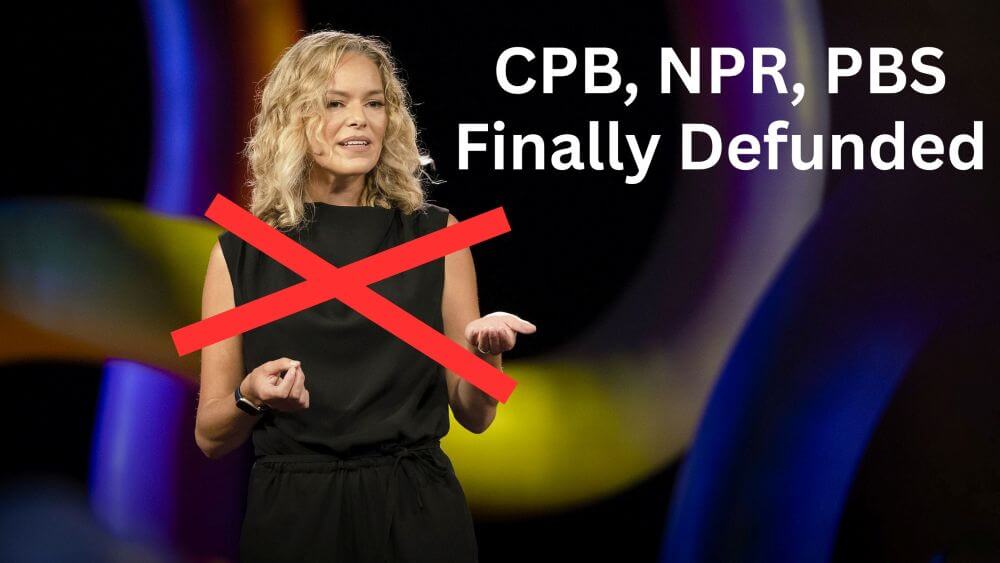
In a historic and deeply polarizing development, the Corporation for Public Broadcasting (CPB), the federally funded nonprofit that has supported National Public Radio (NPR), the Public Broadcasting Service (PBS), and hundreds of local stations, announced Friday it is beginning the process of winding down operations. The move comes after Congress officially eliminated CPB’s federal funding following a sustained political push led by President Donald Trump and his allies.
The decision ends nearly six decades of public broadcasting in its traditional form. Established in 1967, the CPB helped create and fund some of the most iconic educational and cultural programming in the United States — from Sesame Street to Frontline to Morning Edition. Yet in recent years, the organization had become a lightning rod for criticism, especially among conservatives who accused it of promoting a consistent left-wing editorial slant.
“This is a huge win for Americans who believe their tax dollars should not be used to support partisan messaging disguised as journalism,” said Rep. Marjorie Klein (R-TX), one of the bill’s co-sponsors.
President Trump, has long called for the dismantling of the CPB, labeling it a “monstrosity” and accusing public broadcasters of pushing narratives hostile to traditional American values. His administration’s budget cut proposal earlier this year quickly gained traction in a Republican-controlled Congress, culminating in a final vote to eliminate the CPB’s $465 million annual appropriation.
“We Can’t Operate Without It”
Executives at CPB stated plainly that losing federal funds leaves them with no path forward. While stations like NPR and PBS receive additional support through member donations and corporate sponsors, the federal subsidy had been vital to keeping smaller stations alive — especially in rural areas where public media is often the only non-commercial source of news and cultural programming.
“The CPB is not just about high-profile shows,” said former CPB president Kathleen O’Shaughnessy. “We helped maintain access to trusted information in communities across the country. That mission is now in jeopardy.”
But critics were unmoved. Many conservatives celebrated the closure as long overdue.
“After decades of taxpayer-funded lectures, filtered facts, and political puppets, the free ride is over,” said commentator Jonah Wexler. “If public media wants to survive, they can fundraise like every other private news outlet.”
A Broader Political Shift
The CPB’s closure is emblematic of a broader trend: increasing scrutiny of taxpayer-funded institutions and a deepening ideological divide over what constitutes fair, unbiased journalism. While supporters argue public broadcasting served as a vital counterbalance to commercial media, opponents say it became a safe haven for progressive politics disguised as objective reporting.
Efforts to reimagine public broadcasting as a non-partisan institution had failed to gain traction in recent years. Calls to “depoliticize or defund” grew louder with each news cycle that critics viewed as skewed or dismissive of conservative perspectives.
What’s Next for NPR and PBS?
Both NPR and PBS released separate statements acknowledging the challenge ahead and confirming that many local affiliates face uncertain futures. While flagship shows may survive on listener donations and foundation support, hundreds of smaller stations could shutter without CPB assistance.
Meanwhile, many Americans are left debating whether the closure of CPB represents a win for fiscal conservatism and political fairness — or a loss for educational and cultural access across the nation.
Regardless of perspective, the message from Congress was unmistakable: federal funding for journalism and media must meet a higher standard of neutrality or face elimination.
“Let private citizens support the content they want,” said Sen. Martin Delaney (R-UT). “Government should not pick sides in the battle of ideas.”
The Corporation for Public Broadcasting will continue limited operations during its wind-down process over the next 12 to 18 months. Its legacy — and the future of public media in America — now hang in the balance.
Previous opinion posts