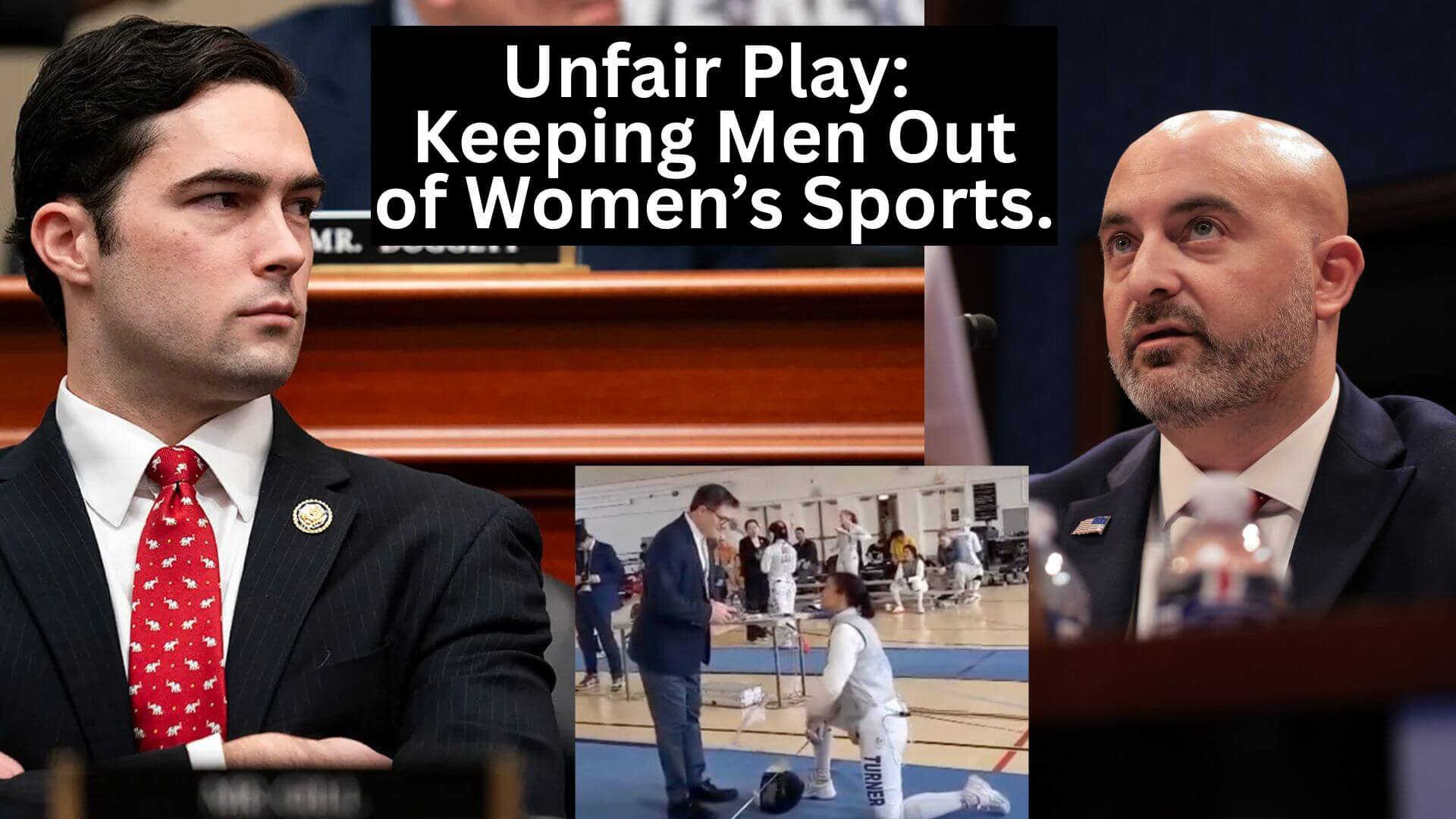
At a fencing tournament at the University of Maryland, a quiet protest became a loud national conversation.
Stephanie Turner, a competitive fencer and lifelong athlete, made a decision that could cost her career—but gained her widespread attention. As she approached the piste to compete in a women’s match, she realized her opponent, Redmond Sullivan, was a biological male identifying as a woman. Rather than quietly comply, Turner took a knee, removed her fencing mask, and refused to compete.
Her silent protest was anything but invisible.
Turner was immediately issued a black card—the most severe penalty in fencing—disqualifying her from the event and possibly putting her entire future in the sport at risk. But Turner insists the protest wasn’t about hate or exclusion. It was about fairness.
“This man can compete in the men’s category or in the mixed category,” she said. “But by choosing to compete in the women’s category, he’s taking away a spot that belongs to a woman.”
Turner’s actions have sparked both outrage and admiration. For some, she’s a villain. For others, she’s a hero standing up against a system that increasingly ignores the concerns of biological women in sport.
The Debate That Won’t Go Away
USA Fencing responded swiftly, affirming its support for transgender inclusion and upholding Turner’s disqualification. But the backlash hasn’t stopped. Across social media, women athletes and supporters are raising the alarm that their voices are being silenced in favor of policies driven by political trends rather than competitive fairness.
The heart of the debate lies here: Should biological males be allowed to compete in women’s categories? And if so, what does that mean for the integrity of women’s sports?
Turner, once a loyal Democrat, says this experience was transformative.
“It was like waking up,” she said. “I voted red down the ticket this year. The mainstream narrative isn’t telling the whole truth.”
Turner’s story has been amplified by a growing chorus of female athletes across sports who feel ignored or sidelined. Many believe the original intent of Title IX—to ensure equal opportunity for women—has been diluted or reversed under current interpretations.
Physical Reality vs. Policy
Turner’s argument isn’t just political—it’s biological.
Males, on average, have faster reflexes, greater upper body strength, more reach, and higher bone density. In a sport like fencing, where split-second reactions and physical reach can mean victory or defeat, these factors are not insignificant.
Yet, according to USA Fencing’s current policies, these biological advantages are overlooked in favor of “inclusion.” But inclusion for whom?
“USA Fencing’s claim of inclusivity is, in reality, exclusive,” Turner said. “It excludes women from having a space of their own.”
This isn’t just an emotional or cultural argument—it’s becoming a legal one too. On May 7th, the U.S. House Subcommittee on Delivering on Government Efficiency (DOGE) held a hearing titled “Unfair Play: Keeping Men Out of Women’s Sports.” Lawmakers, including Congressman Brandon Gill, sharply questioned athletic leaders about the fairness and legality of current policies.
Gill’s questioning revealed inconsistencies and disturbing statements made by USA Fencing-affiliated individuals. From public mockery of concerned parents to inappropriate social media posts targeting conservatives, the hearing spotlighted an organization seemingly out of touch with many of its athletes and supporters.
Where Do We Go From Here?
Turner’s act of defiance may be the first of many. Across sports—from swimming to track to cycling—female athletes are beginning to resist quietly imposed rules that they believe endanger fairness, safety, and the future of women’s competition.
As a society we want to protect the purpose of women’s sports, we want to provide a level playing field for female athletes to compete, grow, and excel.
Stephanie Turner’s courage raised a mirror to a growing problem.
In a match she never fought, Turner became the most powerful fencer on the piste.
Not through aggression, but through conviction.
Conclusion
Women’s sports were created to give women a fair chance to compete. If we erase the distinction between biological sexes in competition, we risk undermining decades of progress. It’s time to listen to the women—before there’s no women’s category left to protect.
Transcripts of the questioning
Congressman Brandon Gill: Mr. Lightfeld, I’d like to ask you a few questions. Do you think that men should be allowed in women’s locker rooms?
Mr. Lehfeldt: Sir, those regulations are set by—
Congressman Brandon Gill: I’m just asking yes or no. Do you think men should be allowed in women’s locker rooms?
Mr. Lehfeldt: I don’t have a personal opinion on that.
Congressman Brandon Gill: You don’t? You have personal opinions on a lot of things but not on that?
Mr. Lehfeldt: It’s a locker room. It’s not really an area where people interact.
Congressman Brandon Gill: So the answer is yes? I don’t think men should be allowed to share showers with women in athletic facilities. Showering is a private activity and should remain private. There are often communal showers. Are you okay with men showering with women?
Mr. Lehfeldt: I don’t have an opinion on that in the context of the USA.
Congressman Brandon Gill: Interesting. That’s astounding. I think most normal people have an opinion on that. Are you okay with women being at a disadvantage when competing against men in sports?
Mr. Lehfeldt: Mixed events happen all the time—
Congressman Brandon Gill: That’s not my question. Are you okay with cisgender females being at a disadvantage if their competitors are male?
Mr. Lehfeldt: Assuming the competitors have met the requirements set forth in the policy—
Congressman Brandon Gill: Then why did you post on social media? You were asked an anonymous question, and you posted your response publicly. You were okay with cisgender females being at a disadvantage?
Mr. Lehfeldt: I believe Congressman Cloud asked me about that. I’m happy to address it again. That was a one-word answer to a more nuanced topic. If I could go back, I’d explain it more fully than I did at the time.
Congressman Brandon Gill: Do you think that parents who don’t want their daughters competing against men in sports are “whiny”?
Mr. Lehfeldt: No, sir.
Congressman Brandon Gill: Then why did you write that on social media? I have the post here. You were responding to a parent who didn’t want their daughter competing against men. You wrote: “I’m not going to pull her from the sport and write a whiny email announcing my departure.”
Mr. Lehfeldt: That was inappropriate. I regret it, and I deleted it shortly after posting. I no longer feel that way.
Congressman Brandon Gill: Do you think parents who don’t want their daughters competing against men in sports should be compared to the Ku Klux Klan?
Mr. Lehfeldt: Absolutely not.
Congressman Brandon Gill: Then why did you do that in your message?
Mr. Lehfeldt: That was inappropriate, and I acknowledge it.
Congressman Brandon Gill: I’d like to read what you wrote. You responded to a concerned parent: “The only wizard that’s going to dig you out of the myopic hole you put yourself and your family in is of the grand wizard variety.” Inappropriate?
Mr. Lehfeldt: Yes, sir. I acknowledge that I wrote it and I commit to never making a message like that again.
Congressman Brandon Gill: Was this a real email from a parent?
Mr. Lehfeldt: It was written by someone claiming to be a parent. They were not a member of our organization.
Congressman Brandon Gill: Were you that person?
Mr. Lehfeldt: No, sir.
Congressman Brandon Gill: But you staged the whole interaction?
Mr. Lehfeldt: The response was not real. I regret that.
Congressman Brandon Gill: Inclusivity is presumably a big part of the fencing community?
Mr. Lehfeldt: Yes, sir. We are a very welcoming community, and I’m proud of that.
Congressman Brandon Gill: Are you welcoming to Trump supporters?
Mr. Lehfeldt: Absolutely.
Congressman Brandon Gill: Then why did you post on your Facebook page, as “The Fencing Coach”: “Imagine being one of 71 million people dumb enough to vote for the reelection of a treasonous clown who’s permanently banned from Twitter for inciting an insurrection, you mad MAGA bros.”
Mr. Lehfeldt: I acknowledge I stated that in my personal capacity.
Congressman Brandon Gill: That was under your public persona, “The Fencing Coach,” correct?
Mr. Lightfeld: Yes, that is my blog and my publication. I acknowledge writing that.
Congressman Brandon Gill: Thank you. My time is up.
Previous Politics posts