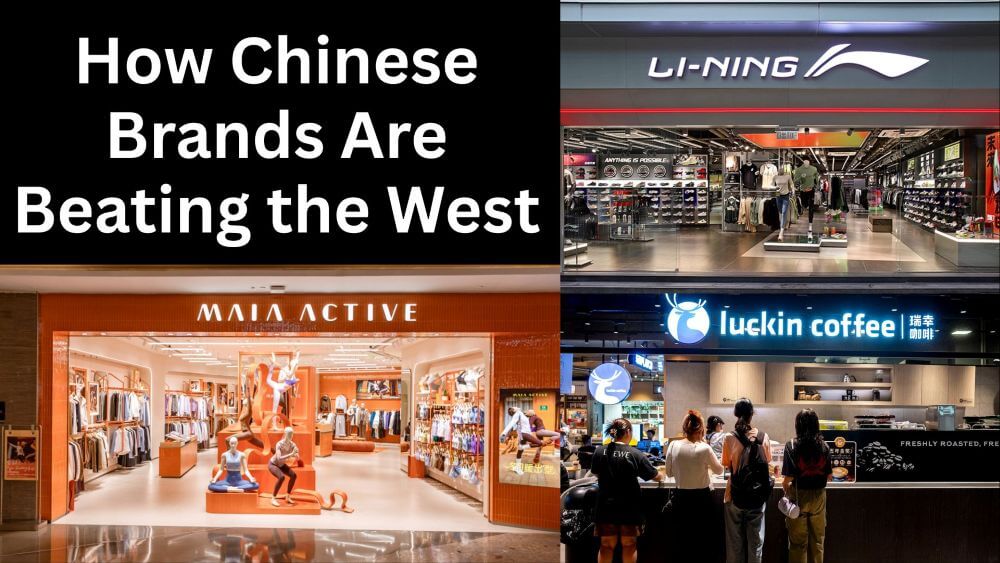
There’s a brand war happening right now, and you don’t need a trade summit or a tariff spreadsheet to see it. You just need to walk around China.
Western brands aren’t being pushed out by cheap knockoffs. They’re being replaced by better local competitors.
Take coffee. Starbucks was once the default symbol of middle-class aspiration in China. Today? Luckin Coffee has blown past it. Over 22,000 stores, higher quarterly revenue, aggressive pricing, and relentless execution. Luckin even markets quality using Western cues—foreign baristas, Italian aesthetics—while being unapologetically Chinese-owned. Starbucks didn’t “fail” in the traditional sense; it just lost relevance.
The same pattern is everywhere.
Maia Active is effectively a Lululemon / Alo Yoga clone—but that description understates what’s happening. Maia didn’t just copy the product; it fixed the mismatch. Western athleisure brands are designed around Western body proportions. Maia designed explicitly for Asian women, nailed the fit, kept premium materials, and priced it slightly lower. That’s not a ripoff. That’s a superior product-market fit.
Once Chinese consumers realize that, the switch is permanent.
You see it again with Ju Active vs. Lululemon, Li Ning vs. Nike. These aren’t budget substitutes. They’re aspirational domestic brands, and in some cases, they’re still expensive—arguably too expensive for domestic production—but consumers are paying anyway because the value proposition makes sense for them.
This is what economic nationalism looks like on the ground—not slogans, but checkout counters.
Tariffs Don’t Fix This Problem
From a geopolitical standpoint, this should make Western policymakers nervous.
We can slap tariffs on Chinese goods all we want. China will retaliate. But the deeper issue isn’t trade balances—it’s consumer loyalty. China represents 1.4 billion people, one of the largest consumer markets in history. When Western brands become too expensive, too generic, or too slow, Chinese consumers don’t wait. They move on.
And when they move on, they don’t come back.
This isn’t about “cheap Chinese copies.” These are real brands, using high-quality materials, building emotional loyalty, and scaling fast. Once local brands dominate domestically, they gain the volume, confidence, and capital to expand abroad.
We’ve already seen this play out in other sectors.
Semiconductors are a perfect parallel. The West can restrict ASML machines and advanced chips, but China will develop alternatives. Maybe they lag at first. But by the time they catch up, Western firms won’t just have lost technological leverage—they’ll have lost customers.
Markets forgive late technology. They don’t forgive irrelevance.
The Data Backs the Anecdotes
This isn’t just “vibes.”
- 72% of Chinese consumers say local brands better reflect their culture and identity
- 52% believe domestic brands offer better value than Western ones
- In EVs, Chinese companies hold nearly 90% of the domestic market
- BYD outsold Tesla globally in 2024 (4.27M vs. 1.79M units)
- China’s Top 100 brands grew 25% in value to $968B
- Xiaomi’s brand value surged 154% through diversification
- Mixue surpassed McDonald’s as the world’s largest fast-food chain by outlets
Western brands aren’t disappearing, but China has shifted from being a profit goldmine to a brutal testing ground. Many foreign firms are retreating, partnering with local PE, or downsizing expectations.
The momentum is unmistakable.
This Isn’t a Moral Judgment—It’s Macro Reality
I don’t have a dog in this fight. I’m not rooting for China or against the West.
But as an observer of economics and incentives, it’s fascinating to watch industrial policy, cultural confidence, and consumer behavior align in real time. This is what deglobalization actually looks like—not collapse, but fragmentation.
Chinese brands are winning at home. They’re increasingly competitive abroad. And tariffs, bans, and moral posturing won’t reverse that trend.
Ignoring it won’t either.
So How Can a Westerner Invest in the Chinese Economy?
Not as a fanboy. Not blindly. But rationally.
1. Public Chinese Equities (Selective, Not Broad)
Avoid “China as a whole” ETFs if you don’t trust policy risk. Instead, look for:
- Consumer-facing leaders (athleisure, food & beverage, personal tech)
- Companies with domestic dominance first, overseas optionality second
- Firms aligned with government priorities (EVs, AI, manufacturing, energy)
Think brands and ecosystems, not commodities.
2. Hong Kong–Listed Companies
HK listings often offer:
- Better governance standards
- More transparent financials
- Less headline risk than mainland A-shares
Many of China’s strongest consumer and tech firms trade there.
3. Private Market Exposure via Funds
If you qualify:
- Asia-focused venture or growth equity funds
- Consumer, logistics, or industrial automation themes
- Avoid speculative real estate or debt-heavy plays
China’s innovation is increasingly happening outside mega-tech.
4. Global Companies Leveraging Chinese Brands
Some Western or multinational firms:
- Manufacture in China
- Partner with Chinese brands
- Distribute Chinese products globally
You’re indirectly betting on Chinese competitiveness without full China exposure.
5. Cultural Arbitrage
The biggest opportunity may not be owning Chinese brands—but recognizing which ones will resonate globally before they do. Ten years ago, few took BYD seriously. That mistake won’t repeat forever.
Final Thought
The real takeaway isn’t “China is winning” or “the West is losing.”
It’s this: consumer capitalism doesn’t care about geopolitics.
Consumers choose what fits them best—culturally, economically, emotionally. Right now, Chinese brands are doing a better job serving Chinese consumers than Western brands are.
And once that loyalty is earned, tariffs don’t undo it.
They just make the divide permanent.
Previous stock market posts