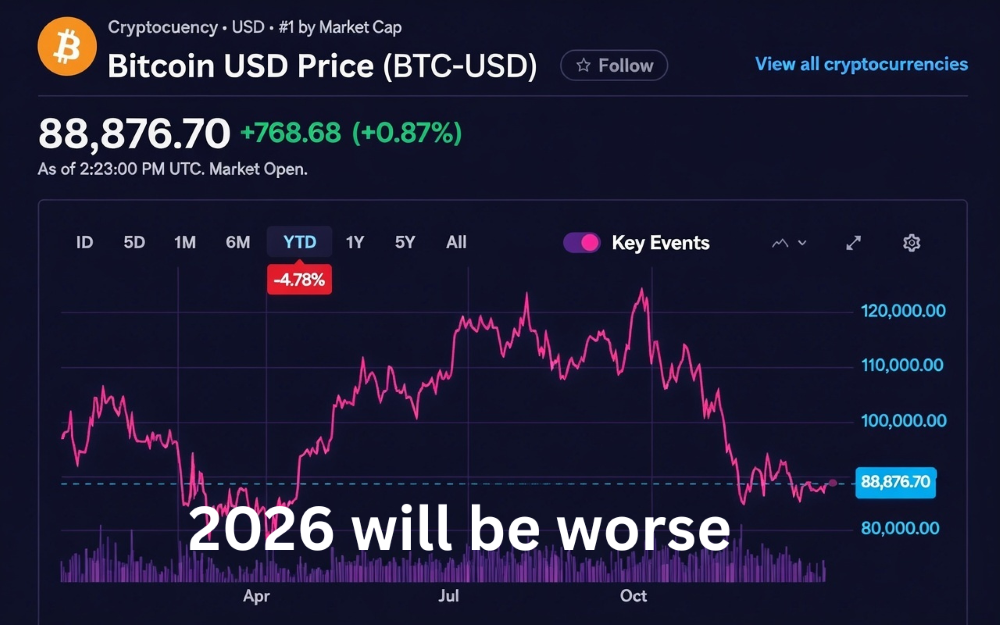
Bitcoin was supposed to be many things: digital gold, a hedge against inflation, a revolutionary alternative to money itself. In 2025, it has turned out to be something far more mundane—a disappointing asset with no intrinsic value and shrinking excuses.
Let’s start with first principles. Bitcoin has no intrinsic value. It does not produce cash flow. It does not generate earnings. It does not represent ownership in anything productive. Its value comes from exactly one source: the hope that someone else—ideally a greater fool—will buy it from you at a higher price later.
This is not a controversial statement. It is textbook Greater Fool Theory. Bitcoin holders are not investors; they are speculators betting that demand from new buyers will continue indefinitely. But here’s the problem: by now, every fool on Earth has already heard of Bitcoin.
The Tulip Mania Parallel Isn’t an Insult—It’s Accurate
Bitcoin enthusiasts hate comparisons to the Dutch Tulip Mania of the 1600s, but the similarities are undeniable. Tulips weren’t valuable because of what they produced; they were valuable because people believed they could resell them at higher prices. Sound familiar?
Tulips collapsed when the pool of new buyers dried up. Bitcoin faces the same mathematical reality. Adoption is no longer early. There is no untapped population waiting to “discover” Bitcoin. Those who wanted exposure already bought in years ago.
What happens next in any speculative bubble is predictable:
- Some holders need real-world money for real-world needs—food, rent, taxes.
- Others look at stagnant prices and lose interest.
- Boredom replaces euphoria.
- Selling begins.
Bitcoin does not fail dramatically all at once. It fails slowly, then suddenly.
2025: An Embarrassing Year by Any Standard
Supporters will try to spin the numbers, but facts are stubborn.
In 2025, Bitcoin declined by roughly 4%.
That alone would be bad enough. But investing is always about opportunity cost.
During the same period:
- The S&P 500 rose about 18%.
- Productive businesses generated profits.
- Shareholders were paid dividends.
- Capital was allocated to companies that actually do something.
Bitcoin did none of that.
A supposedly revolutionary asset losing money in a strong market is not “volatile”—it’s underperforming. A 4% decline isn’t a badge of honor. It’s an embarrassment.
The Myth of Digital Gold Is Dead
Bitcoin was marketed as “digital gold,” yet gold has thousands of years of history as a store of value. Bitcoin has barely survived a few market cycles, all fueled by cheap money and hype.
To make things even more embarrasing for Bitcoin holders, real gold prices went up 67%, breaking the relationship between real gold and digital gold. Real gold is still tangeable and pretty to see, Bitcoin is none of those.
Gold is used in jewelry, electronics, and industry.
The real intrinsit value is that it’s a great tool for criminal activity. When reagular citizens hold Bitcoin, they are adding and abetting the criminals. Bitcoin real usefulness is:
- Money Laundering (Digital Washing Machine)
- Ransomware and Extortion
- Online Black Markets
- Tax Evasion and Income Concealment
- Sanctions Evasion
- Scams and Fraud
Remove hype and liquidity, and Bitcoin has nothing left to stand on.
Prediction for 2026: No New Highs, Likely New Lows
I’ll make a clear prediction:
Bitcoin will never again reach $100,000.
The narrative fuel is gone. Institutional excitement has peaked. Retail enthusiasm is exhausted. Governments are not adopting it as currency, and it has failed as a medium of exchange.
In 2026, a decline of 20% or more is entirely plausible—perhaps even likely. Not because of a single catastrophic event, but because the logic of the asset is fundamentally broken.
When belief fades, price follows.
Final Thoughts
Bitcoin didn’t fail because of regulation.
It didn’t fail because of conspiracies.
It failed because it never had a real foundation.
Speculation can run for years, even decades, but it always ends the same way. Assets without intrinsic value eventually return to their intrinsic value—which, in Bitcoin’s case, is zero.
The emperor still has no clothes.
In 2025, more people are finally noticing.
Previous stock market posts