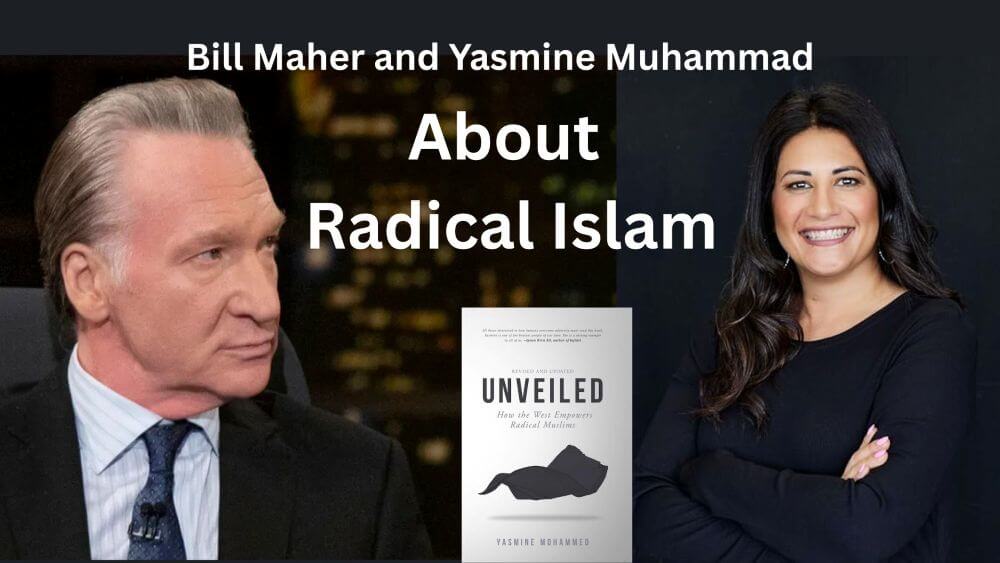
Who Is Yasmine Muhammad?
Yasmine Muhammad is a Canadian human rights activist and author who advocates for women’s rights, secularism, and freedom of expression. Her work focuses on supporting ex-Muslims and challenging oppressive practices, particularly those affecting women in religious communities.
Unveiled: A Journey from Oppression to Activism
She is the author of Unveiled: How the West Empowers Radical Islam, in which she recounts her upbringing in a fundamentalist Islamic household in Canada, her forced marriage to an Al-Qaeda operative, and her journey toward liberation and advocacy.
In the book, she discusses:
- Personal Struggles: Muhammad details the abuse she endured within her family and marriage, highlighting the challenges faced by women living under strict religious and cultural norms.
- Critique of Western Liberalism: She argues that well-intentioned Western liberals often inadvertently empower radical Islamic practices by avoiding criticism in the name of cultural sensitivity, thereby neglecting the plight of women suffering under such regimes.
- Advocacy for Universal Human Rights: Emphasizing that women’s rights are universal, Muhammad calls for a reevaluation of policies and attitudes that allow oppressive practices to go unchallenged in Western societies.
Bill Maher on Yasmine Muhammad’s Story
In one of his monologues, Bill Maher said the following about the book:
“Yasmine Muhammad is a human rights activist who was married off to a Muslim man with fundamentalist views about women—something not uncommon in certain parts of the Muslim world. He forced her to wear the niqab at all times. On one occasion, he even beat her for removing her hijab at home, fearing that someone might see through a window—this happened in Vancouver.”
Reflecting on her experience with veiling, Yasmine said:
*”It just suppresses your humanity entirely. It’s like a portable sensory deprivation chamber. You’re no longer connected to humanity. You can’t see properly, you can’t hear properly, you can’t speak properly. People can’t see you. You can only see them.
Just little things—like passing people on the street, making eye contact, and smiling—that’s gone. You’re no longer part of this world. And so, you very quickly just shrivel up into nothing under there.”*
And that, she says, is her answer when someone accuses her of being an Islamophobe.
What We Can Learn from Yasmine Muhammad’s Message
In the West, we often focus on issues like the wage gap and whether men earn more than women. We fight to correct imperfections in our system. But if we truly want to create the greatest good, we should also be fighting for the rights of women who are forced to live invisible lives under oppressive regimes.
Previous opinion posts