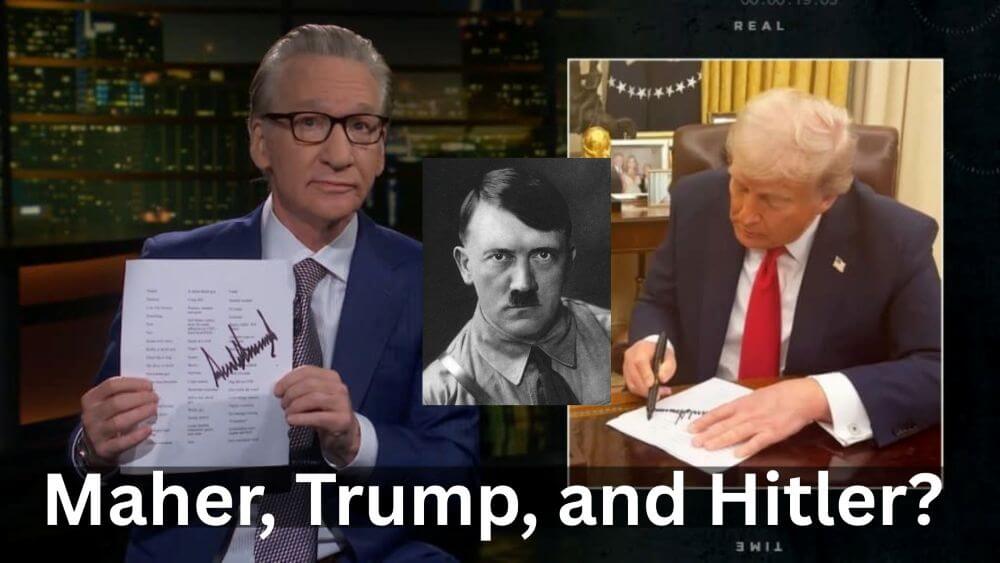
Recently, comedian Bill Maher made headlines when he was invited to have dinner with President Donald Trump at the White House.
Maher explained the surprising dinner, saying:
“As you know, 12 days ago I had dinner with President Trump — a dinner that was set up by my friend Kid Rock — because we share a belief that there’s got to be something better than hurling insults from 3,000 miles away.”
The dinner itself sparked a wave of commentary and reactions.
One of the most notable came from comedian Larry David, who published a satirical essay titled “My Dinner With Adolf” in The New York Times, mocking Maher’s meeting with Trump by comparing it to having dinner with Adolf Hitler.
This satirical jab did not sit well with Bill Maher. In a conversation with Piers Morgan, Maher addressed the essay and the broader issue of invoking Hitler analogies:
Piers Morgan: “You’re friends, aren’t you?”
Bill Maher: “Friends, of course. I mean, this wasn’t my favorite moment of our friendship. I think the minute you play the Hitler card, that’s when you’ve lost the argument. I just think it’s kind of insulting to six million dead Jews. You know, like, that should kind of be in its own place in history.”
Maher’s reaction highlights a growing concern: the trivialization of historical atrocities for political satire or point-scoring.
Journalist Shannon Bream also weighed in on the controversy, criticizing the repeated comparisons of Trump to Hitler:
“This is a president right now who was getting blowback for using executive orders to try to shut down antisemitism on college campuses. So I find it rich that there would be this constant equation of him with Nazism or with Hitler. I think it’s lazy. I think it’s offensive to people who actually suffered at the hands of Hitler, and it kind of just signals that you don’t have an argument if that’s where you go.
But this is a man who is trying to take action against antisemitism. He has a daughter and grandchildren who are Jewish as well. He had the Abraham Accords.”
Author Batya Ungar-Sargon went even further, arguing that the use of Hitler comparisons insults not only Jewish communities but millions of working-class Americans:
“This is a man that is well-loved in Israel and they feel like he’s actually fought on their behalf.
A person whose family members were murdered by the actual Hitler, you know, in addition to it being deeply offensive to Jews, sees calling Trump Hitler as calling over 80 million Americans — 35% of Jewish Americans, 56% of Hispanic men, and the majority of Americans who make under $100,000 a year — Nazis.
Those are the people who gave Donald Trump his victory.
And I just have a pro tip for any Democrats who are thinking about winning back the working class: those people making under $100,000 a year, a majority of whom voted for Trump — you should have a visceral disgust for someone like Larry David, who’s worth $400 million, sitting there and sneering and smearing the hardest-working Americans for refusing to cosign their own disinheritance.
When millionaires call Trump Hitler, they are calling working-class Americans Nazis because they chose the person they thought would give their children back the future they were promised by this country. And it just has to stop.”
Conclusion
Political satire has long been a tool for challenging authority and exposing hypocrisy. But when it crosses into territory as serious and painful as the Holocaust, it risks trivializing the suffering of millions and alienating those who might otherwise be open to conversation.
Bill Maher’s dinner with Trump may have raised eyebrows, but the casual use of Hitler comparisons raises deeper questions about how we talk to — and about — each other. If we want to preserve meaningful dialogue, some lines should never be crossed.
Previous opinion posts