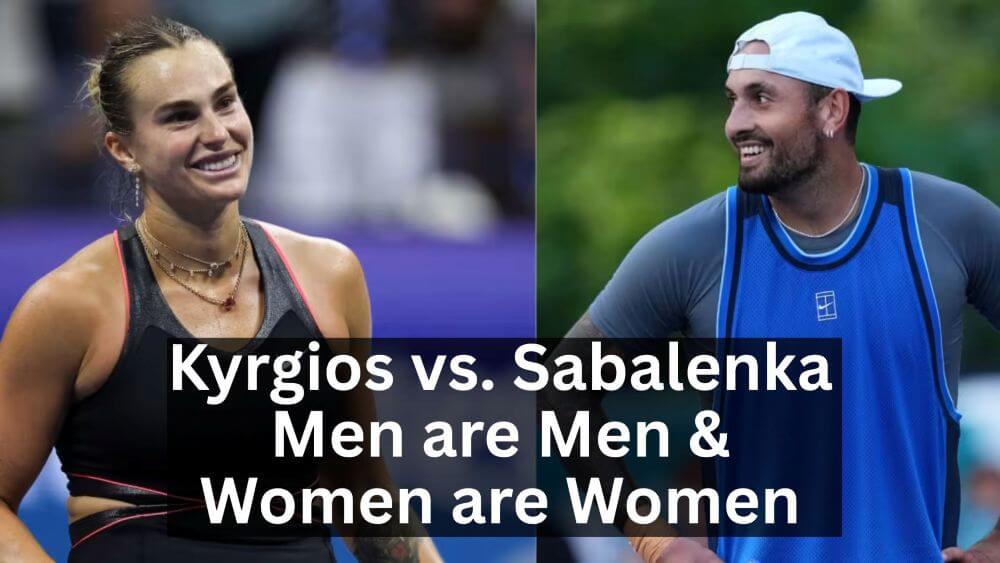
The world of tennis witnessed a captivating yet controversial exhibition match on December 28, 2025, at the Coca-Cola Arena in Dubai, where Australian maverick Nick Kyrgios took on Belarusian star Aryna Sabalenka in a modern “Battle of the Sexes.” Billed as a fun spectacle to engage fans ahead of the new season, the event quickly sparked deeper conversations about gender differences in sports, the fairness of competition, and the ongoing debate surrounding transgender athletes in women’s categories.
The Match: A Dominant Display Despite Handicaps
Nick Kyrgios, now 30 years old and ranked 671st in the ATP standings as of December 2025, has been plagued by injuries, playing just six tour-level matches over the past three years. His highest career ranking was 13th back in October 2016, but he’s far from that peak form now—admittedly unfit and inactive. Facing him was Aryna Sabalenka, the world’s top female player and a four-time Grand Slam champion, known for her explosive power and relentless baseline play.
To make the matchup more competitive, special rules were implemented in Sabalenka’s favor: only one serve per point (no second serves), and her side of the court was reduced by about 9% in size—accounting for the average speed difference between men and women, making it easier for her to reach balls but harder for Kyrgios to find his targets. Despite these advantages, Kyrgios cruised to a straight-sets victory, 6-3, 6-3. The match was entertaining, with underarm serves, playful banter, and even Sabalenka dancing during timeouts to energize the crowd. Kyrgios held back at times, playing casually, while Sabalenka went all out—yet the result was unequivocal.
Post-match, Kyrgios called it a “great stepping-stone” for his Australian Open prep, admitting to nerves despite his win. Sabalenka, gracious in defeat, saw it as valuable practice and teased a rematch for “revenge.” Organized by their shared agency, Evolve, the event aimed to attract younger fans through spectacle rather than make a political statement.
Highlighting Inherent Differences: Why Biology Matters
This isn’t just about one match—it’s a stark reminder of the physiological gaps between male and female athletes. An unfit, low-ranked man like Kyrgios can still overpower the best woman in the world, even with rules tilted against him. Men’s tennis benefits from advantages in strength, speed, and endurance, driven by biology: higher testosterone, greater muscle mass, and superior aerobic capacity. These differences explain why a player outside the top 600 can dominate a Grand Slam champ.
Historical parallels abound. In 1998, a 203rd-ranked Karsten Braasch beat both Serena and Venus Williams consecutively. The 1973 King-Riggs match was iconic, but modern exhibitions consistently show the same trend. Sabalenka’s smaller court was meant to bridge the 9% average speed gap, yet it wasn’t enough. If Kyrgios simply declared himself transgender, “she” could theoretically become the top “female” player overnight—highlighting the absurdity and unfairness of ignoring biology.
The Backlash: Media Narratives and Misogyny Claims
The result didn’t sit well with everyone. Reports suggest the ABC (Australian Broadcasting Corporation) expressed disappointment, framing Kyrgios’s win as a setback for women’s progress. One critique reportedly stated: “Nick Kyrgios is a man that stands for something—and that’s not an accident. He is choosing to stand for and represent misogyny.” Of course, proving that an inactive man outperforms the women’s No. 1 is labeled “misogyny” because it challenges narratives that downplay gender differences. The media’s push to blame “toxic masculinity” for performance gaps fell flat here. Instead of celebrating the fun, some saw it as a “mockery,” licking their wounds and plotting new ways to advance a “men-bad, women-good” storyline for 2026.
But this isn’t misogyny—it’s reality. Pretending men and women are identical in physical sports doesn’t empower anyone; it erodes fairness. The ABC’s reaction underscores a failure to stay grounded, ignoring science in favor of ideology.
Why This Matters for Transgender Athletes in Women’s Sports
Ultimately, the Kyrgios-Sabalenka clash reinforces why women’s sports need single-sex categories. Transgender women who transition after male puberty retain advantages like bone density, lung capacity, and muscle strength—edges that no amount of hormone therapy fully erases. If a low-ranking man can beat the best woman, imagine the imbalance if trans women (biologically male, regardless of identity) compete in female divisions. It’s not about denying rights; it’s about protecting opportunities for biological women.
This is why there’s no place for transgender women in women’s sports—it’s totally unfair to real women. Trans women are, in reality, men with lipstick, and allowing them in erodes the level playing field that separate categories were designed to create. Policies from bodies like World Athletics recognize this, barring those with male puberty advantages from elite female events. Tennis should follow suit to preserve integrity.
Events like this aren’t setbacks; they’re demonstrations of truth. Women deserve spaces where they can compete equally, without biological disadvantages tipping the scales.
What do you think? Does this match prove why we need to keep women’s sports for biological women only? Comment below.