At the heart of society’s identity debates lies a simple, undeniable fact: every human being is born male or female. That’s basic biology. Not “a preference.” Not “an ideology.” Simply a fact. So when you hear claims that insisting on biological sex is somehow “discrimination,” ask yourself: discrimination against what exactly? How does acknowledging biological truth demean or demean someone else?
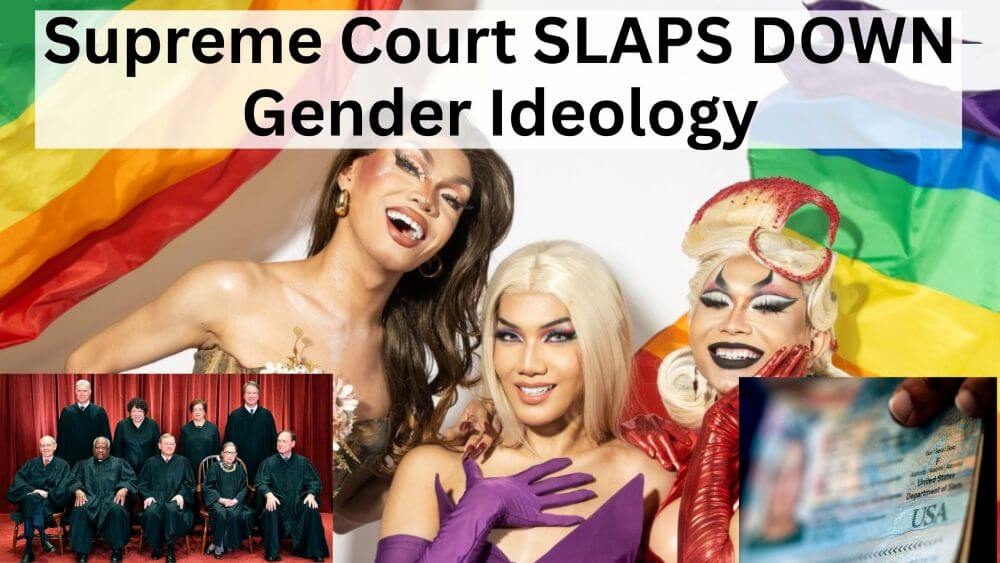
The recent decision by the Supreme Court of the United States on November 6, 2025 is a case in point. In a decision that handed a major win to the Donald Trump administration, the Court allowed the U.S. to revert to listing only “M” or “F” on new or renewed passports, based on sex assigned at birth — eliminating self-declared options such as “X” or gender identity markers formerly permitted.
What the ruling says — and why it matters
The ruling is brief but clear. The government argued that listing a person’s sex at birth is merely stating a historical fact and does not amount to discrimination. The Court agreed, saying:
“Displaying passport holders’ sex at birth no more offends equal-protection principles than displaying their country of birth — in both cases, the Government is merely attesting to a historical fact without subjecting anyone to differential treatment.”
In short: The Court is treating sex as an immutable datum, not as an identity narrative to be updated on demand. The Biden era’s policy change had allowed a passport marker “X” and changes based on self-identification — that has now been halted for new applications.
For those who believe in a “biology-agnostic” vision of society, this may seem like a setback. But for folks who believe that social cohesion, clarity in documentation, and respect for biological fact matter, this decision is a corrective.
Why common sense people are celebrating
- Restoring clarity in official documents – If a passport says “M” or “F” based on sex at birth, then foreign governments, border officials, etc., will have a consistent marker tied to birth records. The administration argued earlier that lack of consistency could expose travellers or burden the U.S. in foreign relations.
- Halting ideological drift – The policy change under the previous administration (allowing “X” and self-declared gender markers) was seen by many as a slippery slope: document after document drifting away from biological sex into self-identity. This ruling draws a line.
- Affirming biology over ideology – The broader cultural war over sex and gender often presents biology as oppressive and “identity constructs” as progressive. But if the government returns to biology-based markers, it signals acknowledgement that sex differences are real, significant, and worthy of legal recognition.
The left’s dissent and what it reveals
The three liberal justices (Ketanji Brown Jackson among them) dissented. Justice Jackson wrote that the Court’s ruling ignored the very real harm the new policy poses for transgender and non-binary individuals — increased vulnerability, mismatch between identity and documentation, risk of discrimination or violence.
What this dissent reveals is important: For the left, recognizing someone’s self-declared gender is more than an accommodation. It is, they argue, a token of respect and equality. But when that self-declaration comes into conflict with biological sex and longstanding documentation norms, the question becomes whether every document, every law, every policy must pivot to identity rather than fact.
The ruling suggests: no. Documents like passports — with international ramifications — will not become identity-expression platforms. They will instead reflect objective fact: sex at birth.
Pushback to expect — and how to respond
Some may say: “But this policy erases me.” To them I say: You aren’t erased. Your lived identity and experience exist independently of what a passport lists. What the policy says is: official travel documents must tie to the record of origin (birth certificate) for consistency.
Others will claim: “It’s discriminatory, it singles out trans and non-binary people.” Real discrimination means unequal treatment under the law. Here, the government treats everyone the same: every new passport must reflect sex at birth. It does not create a category of “trans documents” or “special passports.” The Court found no differential treatment.
Still, some will argue this ruling threatens personal dignity or identity. Here’s my counter: it’s dignified to accept reality. Just as nobody demands we pretend height, eye-color or birth-date are fluid when they aren’t, it’s not absurd to anchor sex in biology when the purpose is identity documentation.
Why this matters for the broader culture
- Document integrity matters. If we allow self-identification to override every official form, we erode the ability of governments to rely on objective data.
- Biology has consequences. Sex differences matter in medicine, in sports, in national security, in travel. Ignoring them doesn’t make them disappear.
- Identity politics is reaching saturation. This ruling is a signal: not everything must bow to gender ideology. Some institutions will still operate on fact, not feelings.
- Choice and consequences. If someone chooses to live as another gender, that’s their prerogative. But they should accept that some things — like passports or other government records — will not necessarily validate that choice for every purpose.
Final word
At the end of the day, basic biology isn’t discrimination. It’s common sense. To insist that everyone must accept or validate every claim of gender identity—regardless of the purpose or context—is to give ideology a veto over fact. That’s dangerous.
This ruling by the Supreme Court is not a perfect victory — legal battles continue, and the decision is currently an emergency stay, pending full litigation. But it is a statement: in certain domains, fact matters. Reality counts. And yes — it is okay to say “no” to every institutional shift that places identity above biology.
If you believe in truth, consistency, and clarity, then celebrate this decision. If you prefer a world where all documentation and institutions shift to identity-first markers regardless of biology, prepare for a confrontation with reality.
The question really is: Are we going to live in a world where the government measures identity by feeling, or by fact? This decision says: for passports, we’ll stick with fact.