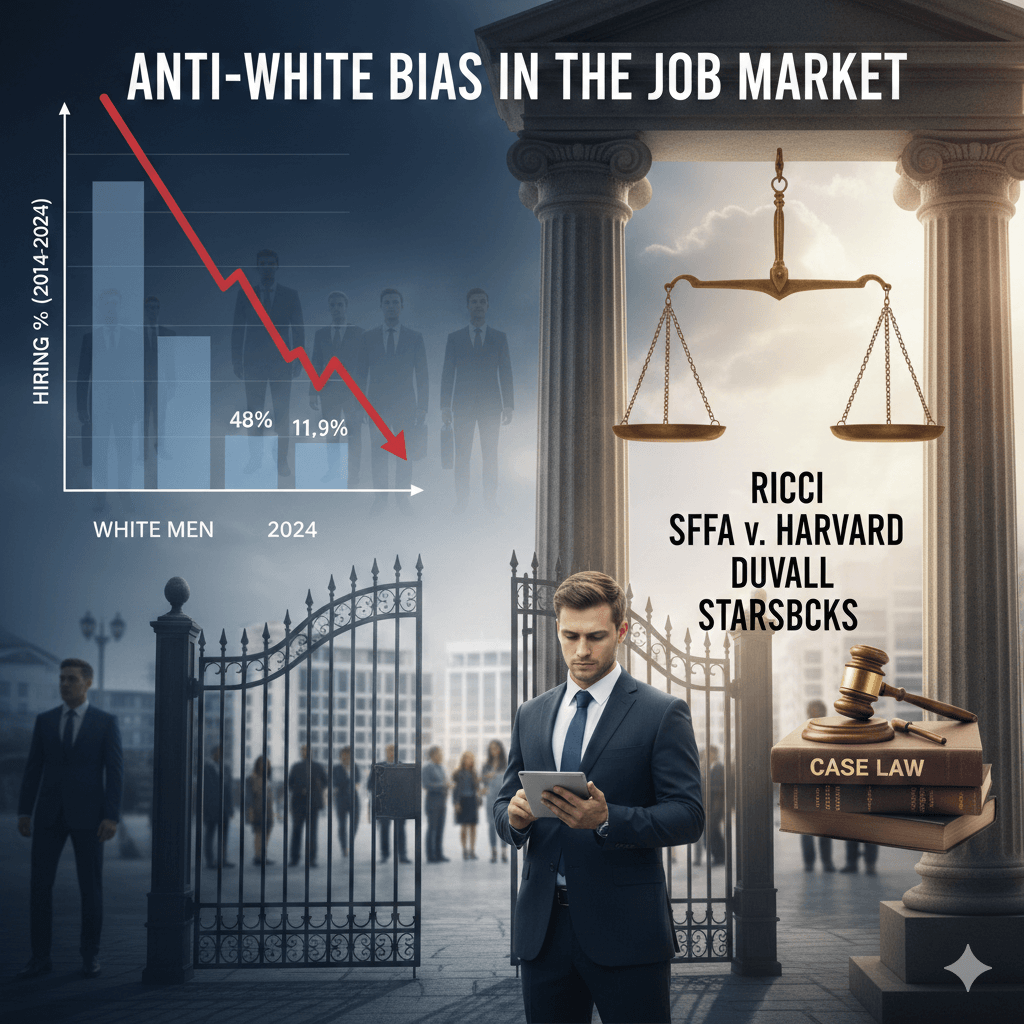
Something extraordinary happened to millennial white men in professional America between 2014 and 2026, and we are only now starting to talk about it honestly. For a decade, a systemic shift has been occurring under the guise of progress, but the raw data suggests a different story. It’s not progress; it’s anti-white and anti-straight person discrimination
The numbers are staggering and point toward a growing trend of anti-white bias in the job market that has fundamentally altered the career trajectories of an entire generation. From Hollywood writers’ rooms to the hallowed halls of Ivy League academia, the “entry-level” door has been slammed shut for many based purely on their demographic profile.
The Statistical Decline: A Generational Purge
The data from the last decade reveals a sharp, targeted decline in the representation of white men in high-status professional roles. This wasn’t a “gentle rebalancing”; it was a structural exclusion that hit the youngest workers the hardest.
- Television Writing: White men dropped from 48% of entry-level TV writers in 2011 to a mere 11.9% by 2024.
- Academia: At Harvard, white men fell from 39% of humanities tenure-track hires in 2014 to 18% by 2023.
- University Hiring: At UC Irvine, out of 64 tenure-track professors hired in humanities and social sciences since 2020, only 3 were white men.
This shift creates a “lost generation” of professionals. While Gen-X and Boomer white men remain in senior leadership at places like The New York Times (a woke newspaper) or major film studios (also woke), they have implemented diversity mandates that apply almost exclusively to the entry-level positions behind them.
Explicit Policies and the Death of Meritocracy
Many believe these changes are the result of “unconscious bias” or general cultural shifts. However, internal documents prove that anti-white bias in the job market is often a matter of explicit corporate policy.
Internal Hollywood agency documents from 2017 showed specific mandates for writers’ rooms. These directives used phrases like “diverse,” “women and diverse only,” and “emphasis on African American.”
The Disney Writing Program is perhaps the most glaring example. Over a ten-year span, it awarded 107 fellowships; exactly zero went to white men. When a major corporation explicitly excludes a racial group from a gateway program, it is no longer about “inclusion”—it is about exclusion.
The Impact on Medicine, Law, and Big Tech
The trend extends far beyond the creative arts. High-stakes professions that used to rely on strict meritocratic testing have shifted their demographic requirements significantly.
- Medical Schools: White male students dropped from 31% in 2014 to 20.5% by 2025.
- Law Schools: Representation fell from 31.2% to 25.7% in just eight years.
- Big Tech: At Amazon, white male mid-level managers dropped from 55.8% to 33.8% in a decade. At Google, white men now make up less than a third of the workforce.
These aren’t cases of mediocre candidates being passed over. These are highly qualified individuals watching less experienced candidates leapfrog them because they fit a specific demographic profile required by a DEI (Diversity, Equity, and Inclusion) scorecard.
How the Courts are Responding to Anti-White Bias
As these practices have become more overt, the American legal system has begun to push back. Recent rulings suggest that the era of “identity-based” hiring may be facing a reckoning.
Students for Fair Admissions v. Harvard (2023)
This landmark Supreme Court case challenged race-conscious admissions. The Court ruled that race-based admissions policies violated the Equal Protection Clause. This ruling essentially signaled that the “diversity” justification is not a valid reason to discriminate against individuals based on their race.
Ricci v. DeStefano
In New Haven, white and Hispanic firefighters sued after the city threw out promotion exam results because no Black firefighters scored high enough. The Supreme Court ruled that the city could not discard test results solely based on racial outcomes. This remains a cornerstone case against anti-white bias in the job market.
Do No Harm v. Pfizer
This lawsuit targeted a Pfizer fellowship that limited eligibility to specific racial groups, excluding white and Asian applicants. Faced with legal pressure, Pfizer was forced to modify its eligibility criteria to be more inclusive of all races.
Multi-Million Dollar Verdicts: The Price of Discrimination
The private sector is seeing a massive uptick in “reverse discrimination” lawsuits where white employees have successfully sued for being terminated or passed over based on their race.
- David Duvall v. Novant Health (2021): A white senior vice president was fired during a “diversification” push despite excellent performance reviews. A jury awarded him $10 million in damages.
- Shannon Phillips v. Starbucks (2023): After a racial controversy at a Philadelphia store, Starbucks fired Phillips, a white regional director, while keeping non-white managers who were also involved. She was awarded $25.6 million in damages.
These cases prove that when a company fires an employee to “change the optics” of their leadership team, they are committing a federal offense under Title VII of the Civil Rights Act.
Corporate Giants Under the Microscope
Currently, several major corporations are facing intense scrutiny for their hiring practices.
- Nike: The EEOC (Equal Employment Opportunity Commission) is currently investigating Nike for its DEI-related hiring and layoff practices.
- IBM & Red Hat: Multiple lawsuits allege that managers were given financial incentives to hit specific diversity targets, leading to the systematic disadvantaging of white male employees.
- Paramount Global: A former attorney has sued the company, claiming he was replaced by a non-white employee purely to satisfy internal demographic quotas.
Disney anti-white policy
Senior Vice President at The Walt Disney Company details discriminatory hiring practices: “Nobody else is going to tell you this, but they’re not considering any white males for the job,” says Michael Giordano, a Vice President of Business affairs, “there’s no way we’re hiring a white male.”
Michael Giordano reveals Disney uses “code words and buzzwords” to avoid legal action and even mentions a candidate being rejected for not looking black enough.
Giordano also admits Disney gives bonuses to executives for practicing Diversity, Equity, and Inclusion (DEI), agreeing that “diversity helps with financial incentives.” Giordano further claims he’s been denied promotions due to his race.
Nolan’s Odyssey Betrayal: Forcing Diversity onto Helen of Troy in the Name of Wokeness

In the realm of Hollywood’s relentless pursuit of diversity, equity, and inclusion (DEI), Christopher Nolan’s upcoming 2026 adaptation of The Odyssey has sparked heated debate with the rumored casting of Lupita Nyong’o as Helen of Troy—a figure historically depicted in Homeric epics as “white-armed” and “fair-haired,” symbolizing ancient Greek ideals of beauty rooted in aristocratic pallor.
While Nyong’o’s undeniable talent and Oscar-winning prowess could bring fresh depth to the role, this choice smacks of performative wokeness, prioritizing modern social agendas over fidelity to the source material’s cultural and mythological context.
Critics argue it dilutes the epic’s authenticity, much like past adaptations that bent history for contemporary appeal, potentially alienating audiences who crave immersive storytelling untethered from ideological mandates.
As Nolan’s star-studded project, featuring Matt Damon as Odysseus, aims to revive classical tales for a new generation, one can’t help but question if such decisions truly advance inclusivity or merely fuel divisive backlash in the name of progress.
The Rise of “Gatekeeper-Free” Career Paths

Where have these “locked-out” professionals gone? Since traditional institutions—media, academia, and corporate law—have become hostile to white men, they have flocked to decentralized platforms.
The boom in Investing, Podcasting, and Substack is, in part, a reaction to institutional gatekeeping. On these platforms, there are no HR departments checking a diversity box. Success is determined by the market, the audience, and the quality of the content.
The number one independent podcaster in the U.S. is Joe Rogan, a white, male, straight person. He doesn’t have to relly on gate keepers, just on whether people like him or not.
I, a Latino who looks like a white person, I make my living with my blog and out of my investments, I don’t rely on a gate keeper to earn my living.
This migration of talent away from mainstream institutions will likely have long-term consequences for the cultural relevance and competence of those legacy organizations.
Summary: A Call for True Meritocracy
Discrimination, regardless of who it is directed toward, is a moral and legal failure. For the last ten years, anti-white bias in the job market has been packaged as “social justice,” but the human cost is a generation of young men who have been told that their hard work and qualifications matter less than their skin color or sexual orientation.
To restore trust in our institutions, we must return to a color-blind meritocracy where the best person for the job is hired, regardless of their background. Anything less isn’t progress; it’s just a different form of prejudice.
Frequently Asked Questions (FAQ)
Is anti-white bias in the job market legal under DEI initiatives? No. While companies can implement diversity outreach, Title VII of the Civil Rights Act prohibits making specific hiring or firing decisions based on race. Quotas and racial preferences in employment are generally illegal.
What should I do if I feel I’ve been discriminated against? Document all communications and performance reviews. If you are told “the room is too white” or that a “diverse hire” is required for a role you are qualified for, consult an employment attorney.
Does the Supreme Court ruling on Harvard apply to private companies? While the Harvard case focused on education, legal experts agree it sets a precedent that will likely be used to strike down similar race-conscious policies in the private sector.
Leave a Reply