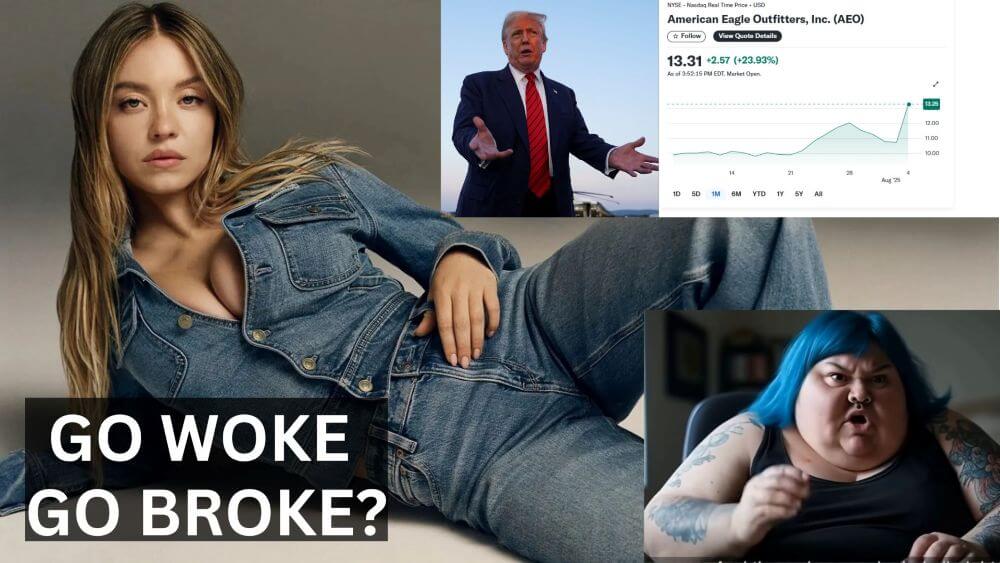
When did a pair of jeans stir up political debate, boost a company’s stock price, and signal a deeper shift in American consumer sentiment? The answer: when American Eagle Outfitters launched an ad campaign featuring actress Sydney Sweeney—a woman with traditional Hollywood looks and, apparently, conservative political leanings.
The result? The campaign didn’t just go viral—it moved markets.
A Simple Slogan, a Not-So-Simple Reaction
The ad featured a clever play on words:
“Sydney Sweeney has great jeans.”
Cue the internet, which quickly pointed out that it could just as easily be read as:
“Sydney Sweeney has great genes.”
To some, it was a cheeky compliment. To others, it was a subtle celebration of white, blonde, blue-eyed beauty—a move that critics labeled “racist,” claiming it echoed outdated beauty standards.
American Eagle responded swiftly:
“‘Sydney Sweeney has great jeans’ is and always about the jeans. Her jeans. Her story.”
But the debate only intensified when Donald Trump posted about it on Truth Social:
“Sydney Sweeney, a registered Republican, has the HOTTEST ad out there… The jeans are flying off the shelves. Go get ‘em Sydney!”
Wall Street noticed. American Eagle’s (AEO) stock shot up more than 20% the following Monday—adding nearly $600 million to the company’s market cap.
The Anti-Woke Consumer Strikes Again
This surge isn’t happening in a vacuum. In recent years, many consumers have grown tired of what they perceive as “woke advertising”—campaigns that promote progressive social causes but often come across as forced, performative, or disconnected from a company’s actual customer base.
Consider:
- Bud Light’s partnership with Dylan Mulvaney, a transgender influencer, led to a boycott and a 20% drop in stock price, wiping out over $26 billion in value.
- Jaguar’s pivot to more “inclusive” branding, including what critics described as “diverse but unattractive” models, coincided with slumping sales and, just last week, the resignation of CEO Adrian Mardell.
Trump, again, didn’t miss the opportunity to drive the point home:
“The tide has seriously turned — Being WOKE is for losers, being Republican is what you want to be.”
Whether you agree or not, the financial results speak volumes.
What This Means for Brands and Investors
The lesson here isn’t that diversity doesn’t belong in advertising. It’s that authenticity matters, and so does knowing your audience.
American Eagle’s campaign worked because it leaned into traditional aesthetics and avoided a heavy-handed message. It connected emotionally and visually with a large segment of the population—and even sparked conversation, which is marketing gold.
In contrast, Bud Light and Jaguar misread their base and got burned. Social media praise doesn’t always translate to sales. In fact, the louder the applause from activist corners, the more likely there’s pushback elsewhere.
Final Thoughts
We’re watching a cultural shift where markets are reacting faster and more strongly to perceived political statements—intentional or not. Brands are being forced to choose: please the activists, or please their customers?
In American Eagle’s case, the strategy was simple: look good, stay ambiguous, let the public run with the narrative.
It worked.
What do you think?
Is the backlash against “woke” marketing justified—or are we entering a new era of performative anti-wokeness?
Let me know in the comments, or join my weekly newsletter at AlainGuillot.com where we talk about finance, culture, and how the world of money reflects the values we’re willing to fight for.
Other posts on Marketing