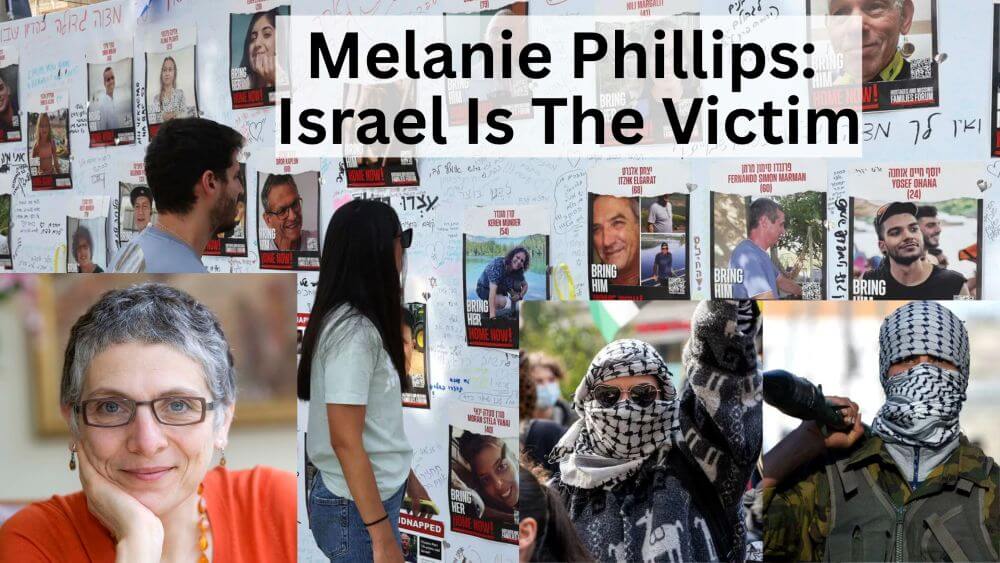
In a podcast, British journalist and cultural commentator Melanie Phillips offers her opinion of our current moment: a West morally unmoored, ideologically blinded, and increasingly hostile toward the truth. Her focus is the escalating misuse of the word “genocide” in the context of the Israel-Gaza conflict, and how this linguistic inversion reveals not only a crisis in the Middle East, but a deeper cultural breakdown in the West itself.
The Progressive Narrative and Its Collapse
Melanie Phillips begins with a sharp critique of the Western liberal psyche. At its core, she argues, is a self-reinforcing identity: “I am good because I am liberal; I am liberal because I am good.” This belief system centers around noble values—compassion, equality, and resistance to oppression. But it also leads to a dangerous oversimplification of global conflicts, where the weaker party is automatically seen as morally superior and the stronger as inherently oppressive.
Enter the Palestinian cause. In this liberal worldview, Palestinians are seen as the ultimate underdog—oppressed, stateless, dispossessed. Supporting them becomes not just a political stance but a moral badge of honor. Israelis, by contrast, are cast as colonial aggressors, the powerful force subjugating the weak.
October 7: A Shattering of Illusions
But October 7 shattered that illusion.
When Hamas militants launched a brutal attack on Israeli civilians—committing acts of savage violence including rape, torture, and mass murder—the liberal narrative was confronted with a horrifying contradiction. The supposed victims had become perpetrators. The supposed oppressors had become the actual victims. Children slaughtered, women raped, families burned alive.
Genocide, Projection, and the Inversion of Reality
Rather than recalibrate their understanding, many doubled down. Unable to reconcile their identity as “good people” with the support they had shown for a terrorist regime, they flipped the script. They accused Israel of genocide. They compared Israelis to Nazis. They projected the worst atrocities committed against Israel onto Israel itself.
This, Phillips says, is not just moral confusion—it’s deliberate moral inversion.
The Erasure of Jewish Suffering
She points to the viral phenomenon of people tearing down posters of kidnapped Israeli hostages—images of missing babies and elderly civilians. These weren’t political statements, she reminds us. These were human beings. And yet, the rage on the faces of those tearing the posters down was visceral.
Why? Because acknowledging those victims would dismantle the comforting fiction of Israeli villainy and Palestinian innocence. To preserve their worldview, Phillips argues, some feel they must erase Jewish suffering from public consciousness. Out of sight, out of mind. Out of the moral equation.
Phillips argues that the West is not just misreading the Israel-Gaza conflict—it is betraying its own values. In the name of anti-colonialism, it ignores Islamist genocidal ideology. In the name of compassion, it dehumanizes Israeli victims. In the name of liberalism, it enables illiberal hate.
As anti-Semitism surges in Western cities and campuses, as propaganda spreads unchecked on social media, and as the word “genocide” is twisted into a political weapon, Phillips insists this is about something bigger than the Middle East. It’s about us. Our intellectual integrity. Our moral clarity. Our willingness to see the truth, even when it challenges our ideological comfort.
A Wake-Up Call for the West
This moment in history is a wake-up call—for those who care about truth, for those who seek justice, and for those who believe that real compassion means standing up not just for the popular cause, but for the true victim.
It is not genocide to defend oneself against genocidal threats. And it is not justice to invert reality in order to preserve one’s ideological self-image. As Phillips reminds us, the stakes are not just geopolitical—they are civilizational.
Previous opinion posts